What Is The Window Of Tolerance In Trauma Recovery?

Written By
Kim Hernandez

There are two ways trauma affects how to think, react, and make decisions.
First, anytime a stressful event happens, your heart starts racing, you react almost immediately, and you make quick decisions to fix things.
Second, stressful moments don’t have any effect on you. You don’t feel or react. In fact, you feel tired, numb, disconnected from the event, almost as if you’re watching it happen as a stranger.
Now, between this cycle of reacting instantly and showing signs of dissociation, there is also a window of tolerance. This window is simply the time when your trauma responses are not hyperactive and you feel normal.
Here, you experience whatever is really happening without a sense of overwhelm or dissociation. You think with clarity, respond and not react, feel more in control.
PTSD makes this window really small, almost non-existent for a lot of people. But as you recover from trauma, this window also widens.
In this blog I have explained everything about the tolerance window and how you can widen it and even make it the new normal.
Key takeaways
- The window of tolerance is the time where you experience emotions and stress while still thinking and responding normally.
- Trauma causes hyperarousal which feels like anxiety, panic, anger, or racing thoughts.
- Hypoarousal also makes you feel numb, exhausted, or disconnected.
- Trauma makes the window of tolerance very short, almost non-existent for many people.
- A window of tolerance doesn’t mean you stay calm all the time. You instead become more flexible and are able to regulate your thoughts and actions.
What is the window of tolerance?

The window of tolerance is the time when you handle a station without getting overwhelmed or completely shutting down.
Now, to be clear, you can feel stressed even inside the window. Also, you can feel sad, angry, nervous, or even frustrated. That’s because a window of tolerance doesn’t guarantee calm every time.
However, even with all these feelings and emotions, you are able to think clearly, make decisions, communicate calmly, and respond instead of reacting.
For instance, let’s say your boss sent you an email asking to talk tomorrow. Now, if you are in the window of tolerance, you can still get nervous thinking about what the conversation will be about.
But then, you will be able to work normally and talk to a trusted friend or co-worker about how you are feeling. Also, you tell yourself that you don’t know yet what the conversation will be about.
So yes, you are aroused, but you manage to be in the present moment and respond to the situation.
As a licensed Denver therapist, I help you process stress, anxiety, and past trauma in a safe, grounded space.

Bonus: If you are able to identity your tolerance window, thank Dr. Daniel Siegel
That’s because the concept of tolerance window was first developed by psychiatrist Dr. Daniel Siegel in his 1999 book, The Developing Mind. It was he who used this to study how people with PTSD shift between different levels of arousal. Today, therapists like myself follow the same concept for trauma therapy in Denver and elsewhere, where we work to gradually widen the tolerance window for people with trauma.
Note: Your window of tolerance is not fixed
Yes, that’s right. You can feel like you have attained normalcy one day, because you are able to reassure yourself and respond well. But then, the other day, you might find yourself in the same loop of trauma-induced hyperarousal and hypoarousal.
This happens mainly because of lack of sleep, chronic stress, illness, exhaustion, or if you remember a traumatic event.
What happens outside your window of tolerance?

When you move outside your window of tolerance, you can go in one of two directions: hyperarousal and hypoarousal.
Complicated as it might look, hyperarousal and hypoarousal are simply two faces of nervous system dysregulation, and two ways your brain responds when something stressful happens.
Think of them as two different ways your system can respond when something feels too much to handle.
First, hyperarousal will make you feel as if things are moving very fast, and make you react instantly.
Second, hypoarousal will make you feel numb, as if everything is completely quiet.
Let’s have a closer look at hyperarousal and hypoarousal and their differences.
Hyperarousal vs hypoarousal
Hyperarousal is an activated state where you feel anxious, angry, restless, overwhelmed, and almost always on the edge. You get racing thoughts, react quickly to even small things, and find it hard to concentrate. Also, you feel that you’ve got to do something about a situation right away.
For instance, let’s say someone sent you a text saying they need to talk. Now, it can mean anything. But you react without even thinking about it, your heart beat increases, and you simply can’t focus on anything. You might also start imagining worst-case scenarios.
Hypoarousal is the complete opposite of hyperarousal. Here, instead of feeling overwhelmed, you feel numb, exhausted, disconnected, and as if you are not present in that moment.
In a situation like this, you’ll notice that you don’t want to talk, can’t make a decision, or don’t care even about things that are important to you.
TL;DR, Here’s how it feels to move between hyperarousal, tolerance window, and hypoarousal:
| You’re experiencing | What it feels like |
|---|---|
| Hyperarousal | Racing thoughts, anxiety, anger, panic, tension, urgency |
| Within your window | Present, connected, able to think, feel, and respond |
| Hypoarousal | Numbness, exhaustion, disconnection, fogginess, shutdown |
How does trauma reduce your window of tolerance?
Trauma changes how you respond to situations that remind you of danger. This can be anything from a person’s tone of voice to being criticized to having conflict with a loved one and a general sense of having lost control. These are also common triggers for emotional flashbacks.
Deep down, you know that you are safe. But then your brain reacts as if something bad is happening right now.
Now, when you are in the window of tolerance, you have a general sense of safety and control, which is why you respond instead of reacting.
But if you have an unresolved trauma from the past, it reduces the tolerance window. And depending on the extent of trauma, your window of tolerance can be moderate, little, to even non-existent.
For instance, let’s say there is a workplace disagreement. The first time or the first few times it happens, you might be able to handle it well.
But if it happens repeatedly, and your unresolved trauma still lingers, your brain can sense danger and start to choose a hyperarousal or hypoarousal response to it. You can either become anxious and try to fix things or you can go in the other direction and completely shut down or resort to work avoidance.
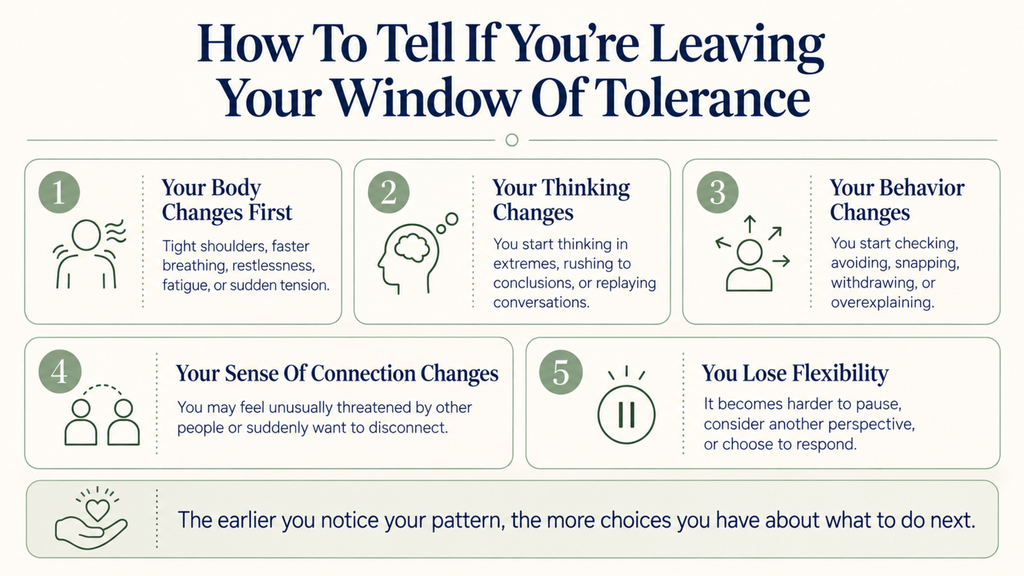
How to know that you are leaving the window of tolerance?
Before you leave the tolerance window and start reacting to things out of hyperarousal or hypoarousal, your brain does give you some clues.
For instance, you will notice that your thoughts are moving fast, you are getting impatient, or constantly checking your phone.
Similarly, you might stop reading or replying to messages, become indecisive, or feel tired. Also, you can feel disconnected from your partner, family, friends, etc., without knowing why.
These are all early signs that you are moving out of your window of tolerance.
How to expand window of tolerance and retain it?
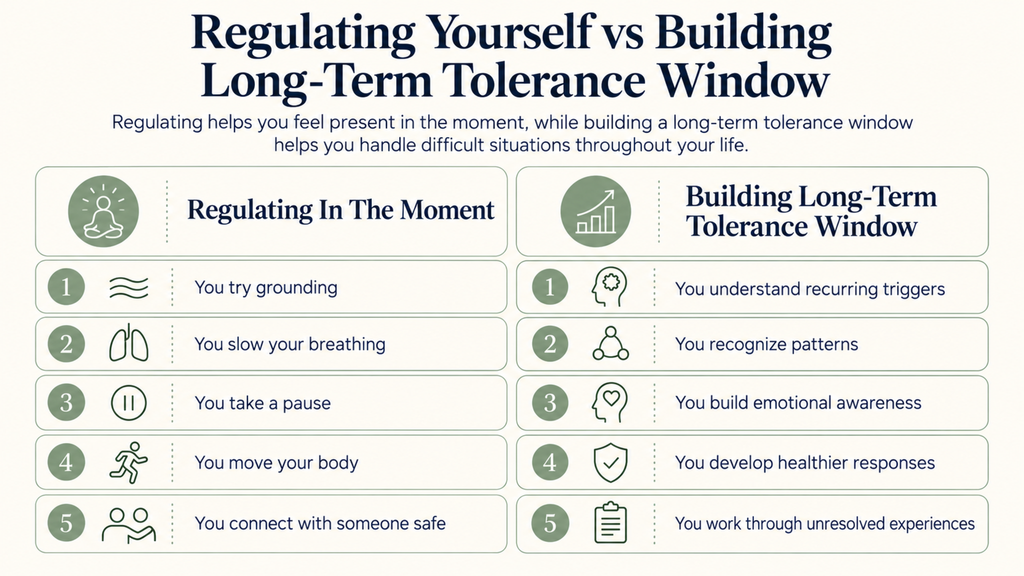
For starters, expanding your tolerance window doesn’t mean you would never become angry, impatient, anxious, or upset. You can have difficult moments and get triggered by them, and that’s completely normal.
Expanding your window simply means you are building capacity which will help you handle difficult or stressful situations without slipping into hyperarousal and hypoarousal.
Here’s how you can do this:
#1. Pay attention to early warning signs
Start paying attention to what happens to you just before you become overwhelmed, such as tightening shoulders, faster talking, becoming quiet, or overthinking. These small changes can tell you that your bring is moving out of the tolerance window.
#2. Know what helps you come back
If you are hyperaroused, doing things like reducing stimulation, orienting yourself to your environment, or slow breathing can help.
If you are hypoaroused, things like gentle movement, going outside, using your senses, or connecting with someone safe can help, which is also the basis of somatic therapy.
Overall, here’s what I suggest my clients to do in different states outside of tolerance window:
| If you notice | You should try |
| Racing thoughts or panic | Slow breathing, grounding, reducing stimulation |
| Anger or intense urgency | Pause, step away, orient to the present |
| Numbness or disconnection | Gentle movement, sensory engagement, safe connection |
| Repeated reactions to the same trigger | Track the pattern and explore what is underneath it |
#3. Build capacity slowly yet gradually
A lot of people think that building capacity means tolerating overwhelming emotions and pushing through them. But it doesn’t in reality. So, don’t force yourself to sit with an overwhelming emotion until it goes away.
If something takes you out of your tolerance window again and again, try to understand why that situation carries so much emotional weight. And then work through using grounding exercises and therapy, if needed, at a pace you can manage.
You might also want to read: 19 Grounding Techniques For Panic Attacks That Actually Work.
As a licensed Denver therapist, I help you process stress, anxiety, and past trauma in a safe, grounded space.
To sum up
The most important thing I want you to understand is that being outside your window of tolerance isn’t a failure.
Use your reaction as information. For instance, if you react out of proportion sometimes, become curious about what might be happening inside you that caused the reaction.
This will eventually lead you to a pattern where some situations and your expectation about it cause you to react in a certain way. And once you have identified this pattern, you can work on things that help stay in your tolerance window in such situations.
Got more questions or want to explore therapy approaches like EMDR to expand your tolerance window?
You can get in touch with me!
At 12:2 Counseling, I offer trauma-informed therapy, including EMDR therapy for PTSD, from my Highlands Ranch office and through telehealth throughout Colorado.
I offer a free 15-minute consultation where we can understand your needs, and create a personalized no-obligation therapy plan for you. We can also discuss your insurance plans and how you can avail them for therapy.
FAQs about window of tolerance
What is the window of tolerance?
The window of tolerance is the range of emotional and physical arousal where you can experience stress and difficult emotions while still being able to think, connect, and respond effectively. When you move outside it, you experience hyperarousal or hypoarousal.
What is the difference between hyperarousal and hypoarousal?
Hyperarousal involves increased activation and can feel like anxiety, panic, anger, racing thoughts, or being constantly on edge.
Hypoarousal involves numbness, exhaustion, disconnection, or shutting down. You can experience both at different times.
Can trauma reduce your window of tolerance?
Yes, it can. Trauma makes your system more sensitive to situations that remind you of danger. This can make it easier to become overwhelmed or shut down.
How can I expand my window of tolerance?
You can start by learning your early signs of dysregulation and practicing ways to return to the present. This includes grounding, movement, breathing, supportive relationships, and professional therapy.
Licensed Professional Counselor Candidate , MA, LPCC
Kim Hernandez is founder of 12:2 Counseling in Denver, helping individuals address trauma, anxiety, addiction-related patterns, and burnout through EMDR, somatic therapy, CBT, and compassionate body-mind-spirit care that supports steadier relationships, emotional freedom, and lasting change forward.