7 Stages Of BPD Relationship Cycle And How To Break That Cycle

Written By
Kim Hernandez

Has it ever happened that your relationship went from being super intimate to very difficult almost overnight?
For instance, you might be feeling very close to your partner yesterday. You talked for hours, felt understood, and thought you’ve finally finally found someone who really understands you.
But then, things changed today. Maybe your partner took longer to respond, wanted some space, or you ended up arguing.
In a situation like this, everything suddenly starts to feel different. You feel disconnected from your partner thinking they are losing interest. Also, you might think that you did something wrong.
This kind of push-pull happens in relationships involving borderline personality disorder (BPD). Here, the intense closeness is followed by fear, conflict, distancing, and sometimes a breakup or separation before the relationship starts again.
Now, a BPD relationship cycle is not a formal clinical model, and not everyone with BPD experiences the seven stages I have explained in this blog. You can think of these stages as patterns that can happen in some relationships.
I have explained these stages from both a clinical and practical perspective, including what can be happening in each stage and where you can begin to break the cycle.
So let’s get right into it.
Key takeaways
- The BPD relationship cycle involves intense closeness, fear of abandonment, conflict, distancing, separation, and reconnection.
- These stages are not a fixed pattern, and not everyone with BPD experiences relationships this way.
- A delayed text, disagreement, or need for space can trigger intense fears of rejection or abandonment.
- BPD push-pull behavior can involve seeking reassurance and closeness while also pushing the other person away.
- Understanding the pattern can help you respond differently instead of reacting to every emotional trigger.
- A healthy relationship is possible for someone with BPD.
What is BPD relationship cycle?

BPD relationship cycle is a repeating pattern of intense emotional closeness followed by fear, conflict, distancing, separation, and sometimes reconnection.
The reason this happens is that people with borderline personality disorder experience intense emotions and have difficulty regulating them. Also, they are highly sensitive to rejection or abandonment, which means they interpret changes in closeness as signs that someone is going to leave.
For instance, your partner might simply need some time alone after a stressful day. But if that distance activates a fear of abandonment, it can feel like much more than needing space. You might get feelings like:
- They are pulling away from me.
- They are losing interest.
- I did something wrong.
- They don’t love me anymore.
- I need to know what’s happening right now.
And when these feelings become very intense, you might act on the fear by seeking reassurance, starting an argument, testing the relationship, withdrawing, or even threatening to leave.
The other partner then reacts to those behaviors. They might become defensive, withdraw themselves, or become overwhelmed and ask for more space. And this reaction then makes your original fear feel confirmed.
As a licensed Denver therapist, I help you process stress, anxiety, and past trauma in a safe, grounded space.

7 Stages of BPD relationship cycle
For starters, BPD relationship stages are not where one person is good and the other is bad.
Both partners can become part of the pattern. One might become fearful and react. The other might feel overwhelmed and pull away.
This withdrawal then increases the first person’s fear, leading to an even stronger reaction.
This pushing and pulling in a relationship can happen even when both partners care for each other. And it can likely involve the following 7 stages:
Stage #1. Intense connection and idealization
The first stage of the BPD relationship cycle can feel exciting.
You will feel like you’ve known each other forever. There can be a lot of affection, attention, emotional sharing, and a strong desire to spend time together. You might also see your partner as unusually special or ‘the one.’
Now, intense connection isn’t a problem as healthy relationships do begin with strong attraction and closeness.
The concern is when the relationship starts carrying the weight of being the only source of safety, validation, or emotional stability.
At this point, the partner is placed on a pedestal. The relationship feels safe, perfect, and almost too good to lose.
And this makes the next stage difficult.
Stage #2. Anxiety and fear of abandonment
Something ordinary happens. Your partner doesn’t respond to a text as quickly as usual, they make plans with friends, or need some time alone. Or maybe you disagree about something.
These things can feel uncomfortable, but they don’t mean your relationship is in danger.
However, when you have a fear of abandonment or an anxious attachment, these small changes can feel much bigger. You might start thinking:
- Why aren’t they responding?
- Are they upset with me?
- Are they losing interest?
- Did I do something wrong?
- What if they leave?
In fact, people with BPD are particularly sensitive to rejection and abandonment. And their relationships can shift between intense closeness and intense conflict or dislike.
Stage #3. Testing, reassurance, and the push-pull pattern
If you have developed a fear of abandonment, you might try to find out whether the relationship is still safe.
This involves repeatedly seeking reassurances, getting upset over small things, picking an argument, threatening to leave, withdrawing, or testing your partner’s commitment.
It creates a BPD push pull pattern where you want closeness but become anxious and want to pull away when your partner gets close. This can also be very confusing for your partner.
EMDR therapist’s tip: If your partner is testing the relationship because they are afraid of being abandoned, it explains their BPD behavior. But it doesn’t mean insults, threats, coercion, or other harmful behavior is acceptable.
Now, if reassurance doesn’t provide the sense of safety someone is looking for, the relationship can move into the next stage of conflict, distancing, and devaluation.
Stage #4. Conflict, distancing, and devaluation
When fear, reassurance-seeking, and emotional tensions continue to build, your relationship can move into a period of conflict. Here, even small disagreements can feel bigger than they are. You or your partner might say things like:
- You don’t care about me.
- You are like everyone else.
- I can’t trust you.
- Maybe we should just end this.
This is also where splitting can become part of the relationship dynamic. The same partner who saw you as completely safe and loving might see you as uncaring, selfish, or untrustworthy.
Now, this doesn’t mean your or your partner’s feelings aren’t real. But the way the situation is being interpreted can change dramatically depending on the person’s emotional state. And this is one of the reasons why BPD relationships feel unpredictable.
Stage #5. Breakup, withdrawal, or emotional separation
At some point, both you and your partner can feel like stopping the conflict. You might leave the room, stop responding, ask for space, think about ending the relationship, or actually break up.
Also, someone with BPD can even end the relationship first thing because leaving feels safer than being left.
The other times, the partner might be the one who finally needs distance because they feel emotionally exhausted.
EMDR therapist’s tip: A breakup doesn’t mean the feelings that existed earlier weren’t real. Your relationship could have been genuinely meaningful. But when emotions are intense and neither person knows how to interrupt the cycle, the relationship can become painful for both people. This is also why I don’t think it’s right to call someone with BPD as toxic.
Stage #6. Reconnection and the cycle starts again
After some time apart, the emotional intensity can settle. You might begin missing your partner, regret what happened, apologize, reach out, or want to reconnect.
Your partner might also be missing the closeness that was there. And when they reconnect, the relationship can feel wonderful again.
There will be relief, affection, promises to do things differently, and a strong feeling that everything is finally okay.
EMDR therapist’s tip: Even at this stage, the underlying pattern hasn’t changed. The same borderline personality relationship cycle can eventually begin again.
Stage #7. The cycle repeats
Even after you reconnect, things can still feel different for a while because the underlying anxious attachment hasn’t healed.
Yes, there will be apologies, promises, affection, and a genuine desire to make things work. And sometimes things really do improve.
But if the underlying pattern hasn’t changed, another trigger can eventually bring the same fears back.
There can be a delayed text, disagreement, partner needing space, or a fear of rejection. And you might feel abandoned again, react strongly, and begin looking for reassurance.
How to break the BPD relationship cycle?
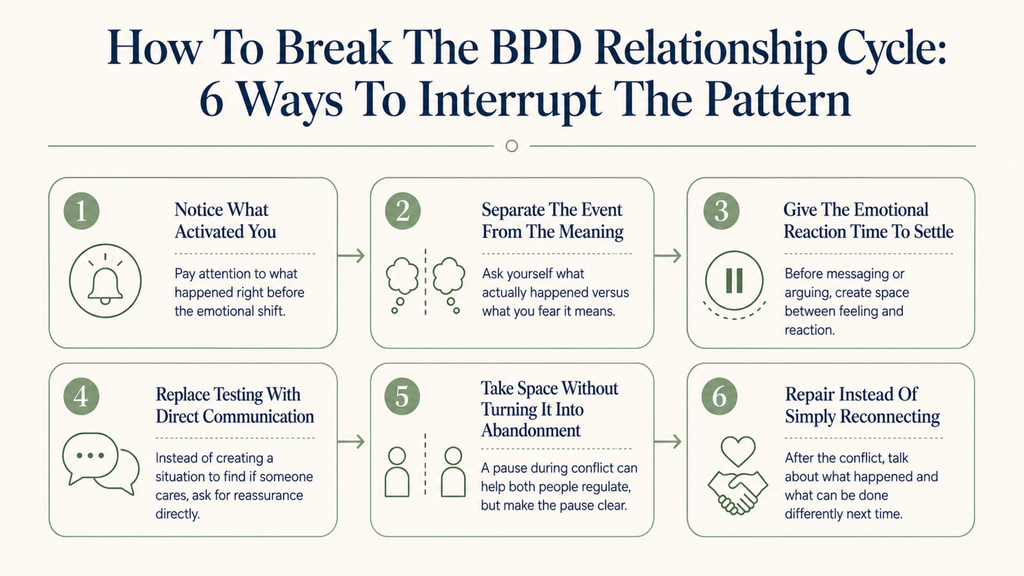
It is possible to break a borderline personality relationship cycle. But it isn’t as simple as better communication. You have to interrupt BPD relationship patterns at several different points.
Here’s how to do it:
#1. Notice the trigger
The first step in breaking the BPD relationship cycle is to recognize is activating the fear. Try to pinpoint the trigger by asking yourself questions like:
- Is it a delayed text?
- A change in someone’s tone?
- Your partner needing time alone?
- A disagreement?
Once you know your triggers, you can start noticing the emotional reaction before it becomes a behavior.
#2. Separate what happened from what you fear it means
This can be one of the hardest steps in breaking BPD push pull.
Try to separate the fact that your partner hasn’t responded in hours from the feeling that they don’t love you anymore.
This small separation will give you enough space to choose a different response.
#3. Pause before reacting
When your emotions are intense, you might try to solve all your relationship problems immediately. And this can make things worse.
So, take a pause, breathe, and step away if you need to. Give yourself enough time for the emotional intensity to come down before you decide what you want to say or do.
#4. Ask for reassurance instead of testing
If what you really need is reassurance, ask for it directly. Instead of creating a situation where your partner has to prove they care, tell them what you are going through.
For instance, you can tell your partner something like: I am feeling very insecure right now and I can use some reassurance.
This is something much healthier than starting a fight to find out whether your partner will reach out to you.
#5. Set healthy boundaries
You might understand why your partner reacts a certain way. But that does not mean you should accept harmful behavior.
Both people in a relationship deserve respect. If there are insults, threats, intimidation, coercion, or abuse, you need to take such behaviors seriously. Compassion and healthy boundaries in relationship can exist at the same time.
#6. Get professional support
BPD is treatable, and psychotherapy is an important part of treatment. Therapy approaches like dialectical behavior therapy (DBT) can help you develop skills for emotional regulation, distress tolerance, relationships, and managing intense reactions.
Want to take the first step towards breaking the BPD cycle?
Join my 12-week DBT skills group therapy in Denver, where you can become part of a supportive, trauma informed group and gain tools to build a calmer, more balanced life.
As a licensed Denver therapist, I help you process stress, anxiety, and past trauma in a safe, grounded space.
Can someone with BPD have a healthy relationship?
Yes.
Having BPD does not mean you are incapable of loving someone, maintaining a relationship, or building a stable and fulfilling life.
But then, I suggest you become aware of unhealthy patterns and work on them.
Also, if you’re the partner of someone with BPD, know that you are allowed to have boundaries too. You can understand where someone’s behavior is coming from while still deciding what is and isn’t acceptable in your relationship.
One last thing
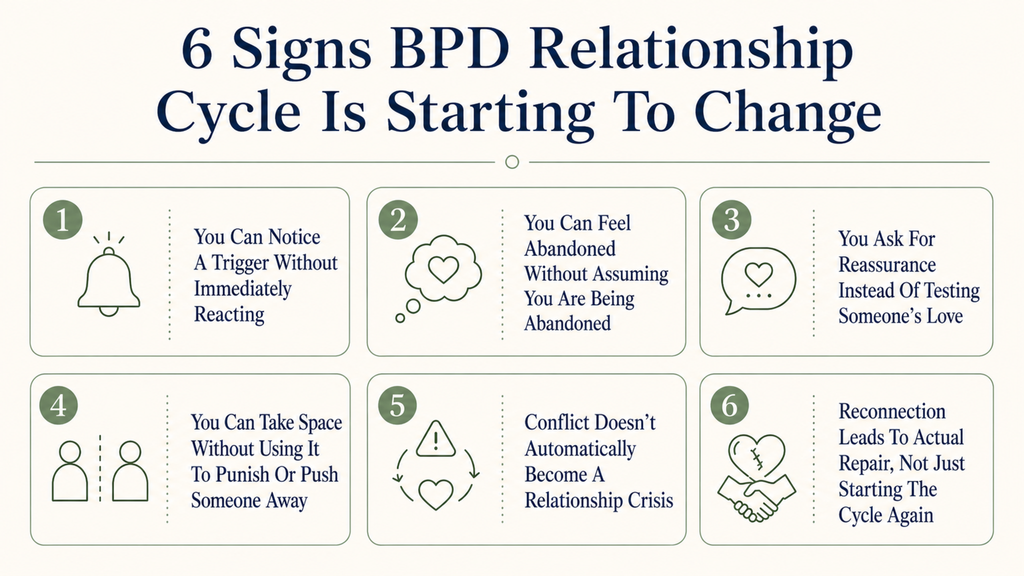
If you recognize yourself in the BPD relationship cycle, I don’t want you to see these seven stages as a label or a prediction of what your relationships will always look like.
BPD patterns can change. The first step is simply noticing what happens between the moment you feel afraid and the moment you react.
That change might be very small at first. But with awareness, support, and practice, you can make bigger leaps in the long run.
Got more questions about borderline personality disorder or want to start therapy in Denver?
You can get in touch with us!
I am an EMDR certified therapist offering one-on-one therapy sessions from my Highlands Ranch office and online therapy throughout Colorado.
FAQs about BPD relationship cycle
What are the stages of the BPD relationship cycle?
The stages of BPD relationship cycle include intense connection or idealization, anxiety and fear of abandonment, testing and reassurance-seeking, conflict and devaluation, breakup or withdrawal, and reconnection.
Note: These are not official clinical stages, and not everyone with BPD experiences this pattern.
How long does a BPD relationship cycle last?
There is no set amount of time. A cycle can happen over days, weeks, months, or longer depending on the people involved and what triggers the pattern.
Why does BPD cause push-pull behavior?
Intense fear of abandonment can create a strong desire for closeness while emotional overwhelm can make closeness feel threatening at the same time. This can create a pattern of wanting connection and then pushing the other person away.
How do you break the BPD relationship cycle?
I suggest you start by identifying triggers, separating facts from interpretations, pausing before reacting, communicating needs directly, and maintaining healthy boundaries.
Is the BPD relationship cycle the same for everyone?
No. BPD affects people differently, and relationship patterns can vary significantly. The seven-stage framework is simply a way of understanding the BPD cycle that can happen in some relationships.
Licensed Professional Counselor Candidate , MA, LPCC
Kim Hernandez is founder of 12:2 Counseling in Denver, helping individuals address trauma, anxiety, addiction-related patterns, and burnout through EMDR, somatic therapy, CBT, and compassionate body-mind-spirit care that supports steadier relationships, emotional freedom, and lasting change forward.