How To Heal Anxious Attachment? Insights From An EMDR Therapist

Written By
Kim Hernandez

Ever noticed how quickly your mind starts racing when someone you care about feels distant?
For instance, if your partner takes longer than usual to reply, you might start checking your phone every few minutes and feel anxious about them losing interest in you.
Well, this is a classic example of anxious attachment, and it can feel very exhausting or even make you sensitive to changes in closeness, communication, or affection. You might crave connection but also spend a lot of time worrying about losing it.
Thankfully, healing from anxious attachment is possible. You can learn how to feel secure and not react to every moment of uncertainty.
I have explained how to heal anxious attachment in detail from my own lens as an EMDR therapist in Denver. Also, I have shared things you can do when your attachment anxiety is triggered.
So let’s get right into it.
Key takeaways
- Anxious attachment makes uncertainty in relationships feel much more threatening than it actually is.
- Healing starts with recognizing your triggers instead of reacting to them.
- Self-soothing can help you pause before seeking reassurance or acting out of fear.
- Building self-trust, boundaries, and a life outside your relationship can reduce your dependence on external reassurance.
- You can learn to communicate your needs without suppressing them or demanding immediate reassurance.
- Therapy is helpful when anxious attachment is rooted in painful or traumatic relationship experiences.
What is anxious attachment?

Anxious attachment is an insecure attachment pattern where you become highly concerned about rejection, abandonment, or losing emotional closeness with someone.
You want closeness, but at the same time, you find yourself constantly checking whether that closeness is still there.
For instance, your partner sends a shorter text than usual. On its own, it is just a short text. But your mind starts filling in the gaps with questions like:
- Are they upset with me?
- Did I do something wrong?
- Are they losing interest?
Before you know it, you are no longer responding to the text. You are responding to everything you fear the text might mean.
The reason behind anxious attachment can be a present-day situation that activates feelings tied to earlier experiences of rejection, inconsistency, abandonment, or uncertainty
This doesn’t always happen to people with a traumatic childhood. Even adult relationships, betrayal, loss, trauma, and other attachment wounds can cause this.
As a licensed Denver therapist, I help you process stress, anxiety, and past trauma in a safe, grounded space.

Here’s a simple way to understand anxious attachment:
| Situations when you’re triggered | What your anxious attachment might tell you |
| Your partner needs space | They’re pulling away |
| They don’t reply quickly | Something is wrong |
| They seem quieter than usual | They’re losing interest |
| You disagree | Maybe they don’t love me anymore |
| You don’t know what’s happening | I need to find out right now |
So how to heal anxious attachment?

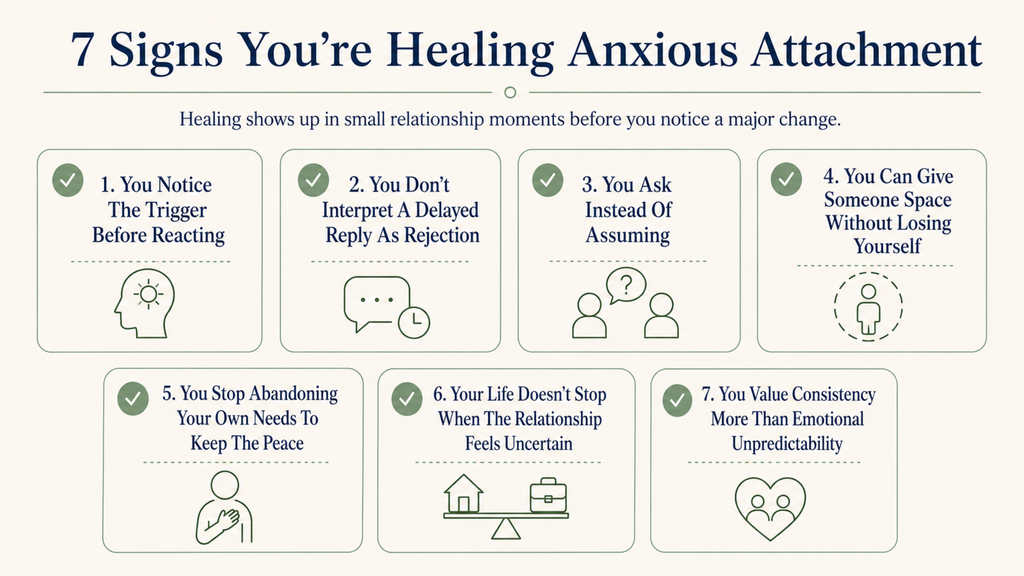
Healing anxious attachment doesn’t mean you stop caring about people or convince yourself that you don’t need anyone.
On the contrary, you learn to stay connected to yourself all the while you’re connected to everybody you know or care about. This is possible with self-awareness, emotional regulation, healthier relationships, and therapy if needed.
All in all, here’s how to overcome anxious attachment in relationships:
1. Notice when your attachment system gets activated
The first step in healing anxious attachment is to recognize your triggers. This can be a delayed text, your partner suddenly seeming quieter, or them making plans without you.
Now, before you immediately call, text, check their social media, or question them, pause and ask yourself:
- What am I feeling right now?
- What am I afraid is going to happen?
- What facts do I actually have?
For instance, there’s a big difference between:
- My partner hasn’t replied for four hours, so they are losing interest; and,
- My partner hasn’t replied for four hours, and I am feeling afraid that they’re losing interest.
The first turns your fear into a fact. The second helps you recognize that you’re experiencing an emotion.
This small difference can give you enough space to choose what you do next.
2. Learn to self-soothe before seeking reassurance
Reassurance isn’t bad. We all need reassurance sometimes.
The problem is when reassurance becomes the only way you know how to calm yourself down.
This is where self-soothing techniques for anxious attachment help.
When you’re activated, try giving yourself a short pause before reaching for your phone. You might:
- Take a few slow breaths
- Go for a walk
- Journal your emotions
- Use a grounding exercise
- Talk to a trusted friend
- Put your phone away and focus on another activity
This will not make your anxiety vanish. But it will surely help reduce its intensity. So much so that you can respond rather than react.
3. Learn to separate your needs from your fears
You can have a genuine need for communication, affection, consistency, or reassurance. And this is different from fear that something is wrong with your relationship.
For instance, you might genuinely need more communication from your partner. That’s a relationship need.
But if you think that your partner will likely leave you when they are not texting you back immediately is a fear.
These two things can exist at the same time. But it is important that you see them separately.
4. Build a life that doesn’t revolve entirely around the relationship
When you’re anxiously attached, it is easy for your relationship to become the center of your world.
Your partner’s mood affects your mood. Their availability decides if you feel okay. You measure how lovable or important you are based on their attention.
Now, healing doesn’t make you become so independent that you never need anyone. You simply build interdependence where you are able to love someone deeply while still having your own interests, friendships, values, boundaries, and routines.
You can start by asking yourself:
- What do I enjoy outside this relationship?
- Am I saying yes because I genuinely want to, or because I am afraid they’ll be upset?
- What boundaries are important to me?
- What do I need in a healthy relationship?
- Can I comfort myself without asking someone else to do it?
Overall, you want to build self-regulation, set boundaries, develop self-trust and maintain a sense of self rather than relying entirely on a partner for emotional security.
Does therapy for anxious attachment help?
Anxious attachment isn’t itself a mental health diagnosis. So there isn’t one specific therapy for anxious attachment treatment that fits everybody’s needs.
But a therapist can still help you understand what’s behind anxious attachment. There can be anxiety, relationship difficulties, past trauma, or experiences of rejection and abandonment that might be subconsciously causing anxious attachment.
A therapist can help you pinpoint the exact cause and even help with long-term solutions. For instance, if past trauma is causing anxious attachment, I can use EMDR therapy for PTSD to help you find lasting solution.
As a licensed Denver therapist, I help you process stress, anxiety, and past trauma in a safe, grounded space.
One final thing
If you are reading this and recognizing yourself in these patterns, please don’t use the label anxious attachment as another reason to criticize yourself.
These patterns developed for a reason. And they can change.
With the right support, you can learn to understand your triggers, regulate your emotions, communicate your needs, build healthier relationships, and develop a greater sense of security within yourself.
If you’re looking for anxious attachment therapy in Denver or throughout Colorado, working with a trauma-informed therapist can be a good place to start.
A therapist can help you understand whether your relationship patterns are connected to earlier experiences and what type of treatment may be most appropriate for you.
FAQs about healing anxious attachment
Can you heal anxious attachment?
Yes. Attachment patterns can change. You can heal by understanding your patterns, learning emotional regulation skills, developing self-trust, communicating your needs, and experiencing healthier relationships.
How long does it take to heal anxious attachment?
There isn’t a fixed timeline. It depends on your history, current relationships, symptoms, goals, and the type of therapy you’re receiving.
Is EMDR good for anxious attachment?
EMDR can help when anxious attachment is connected to distressing or traumatic experiences. However, EMDR is primarily an evidence-based treatment for PTSD rather than a specific treatment for anxious attachment itself.
What is the best therapy for anxious attachment?
There isn’t one therapy that is best for everyone. CBT, attachment-focused approaches, trauma-focused therapies such as EMDR, and other approaches can be appropriate depending on the person’s symptoms and history.
Can you have anxious attachment as an adult?
Yes. Attachment patterns can influence adult relationships, but they aren’t fixed personality types or diagnoses.
Your responses can vary depending on the relationship, circumstances, and how safe and supported you feel.
Licensed Professional Counselor Candidate , MA, LPCC
Kim Hernandez is founder of 12:2 Counseling in Denver, helping individuals address trauma, anxiety, addiction-related patterns, and burnout through EMDR, somatic therapy, CBT, and compassionate body-mind-spirit care that supports steadier relationships, emotional freedom, and lasting change forward.