19 Grounding Techniques for Panic Attacks That Actually Help

Written By
Kim Hernandez

One of the scariest things about having a panic attack is how quickly it can make you feel like you have lost control. Your heart starts racing, thoughts move fast, body feels tense, and suddenly, even a familiar place can feel unfamiliar.
A lot of people also describe panic attacks as a nervous system dysregulation where they feel like something terrible is about to happen, even when there is no danger around. And that can be very overwhelming.
Now, if you have experienced this before, you might have wondered: How do I make this feeling stop or calm myself down?
Well, let me tell you calming is possible in these situations with the right grounding techniques for panic attacks. These techniques are simple and they help bring your attention back to the present moment.
The best thing: You don’t need any special tools or techniques as most grounding exercises can be done anywhere.
In this blog, I will explain it all. You’ll know grounding techniques are, why they can help, and 19 practical grounding exercises you can try during panic attacks.
So, let’s get started.
Key takeaways
- Panic attacks can make your brain feel like you are in danger, even when you are physically safe.
- Grounding techniques for panic attacks help shift your attention away from overwhelming thoughts.
- The 5 4 3 2 1 grounding technique uses your senses to help you reconnect with your surroundings.
- Different grounding exercises work differently for different people, so finding what’s effective for you is important.
- Grounding techniques are a helpful coping tool, but therapy can help address the deeper causes of recurring panic attacks.
What is a grounding technique for panic attacks?

A grounding technique is a strategy that helps you reconnect with the present moment when your thoughts, emotions, or physical sensations feel overwhelming.
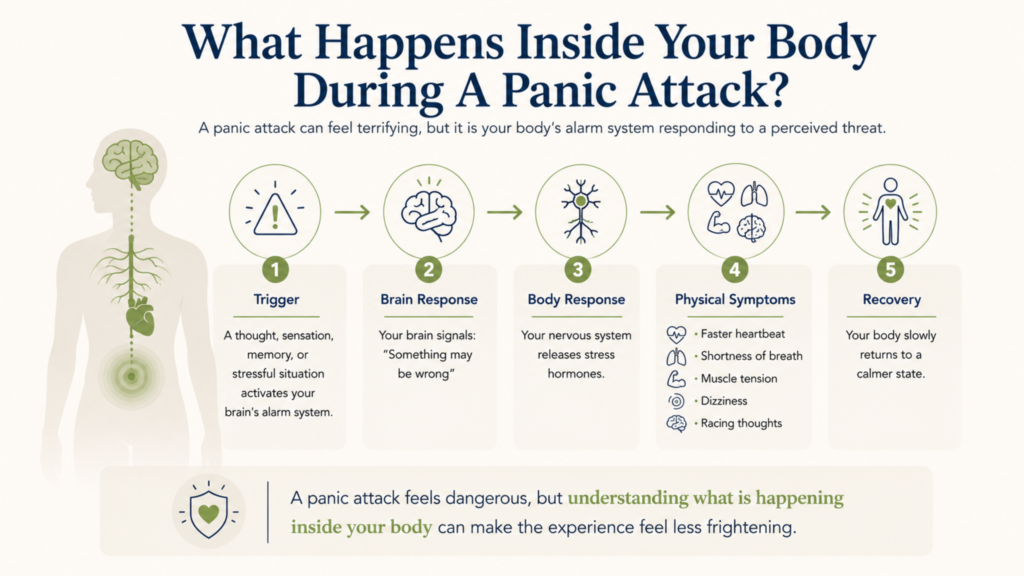
You see, during a panic attack, your body’s natural alarm system becomes activated. And your brain begins to interpret certain sensations, like a racing heartbeat, shortness of breath, dizziness, or intense fear, as signs that something is wrong. This activates your fight-or-flight response.
Now, the problem is that this response can make the experience feel even more frightening. That’s because the more attention you give to the scary thoughts and sensations, the more intense they can feel.
Grounding works by gently bringing your attention back to what is happening around you right now.
For instance, during a panic attack, you might think: ‘my heart is beating fast, something is wrong.’
Now, a grounding exercise helps you shift your attention to: ‘I am sitting in my room, my feet are touching the floor, I am here in this moment.’
This does not mean ignoring your feelings or pretending anxiety is not there. Instead, grounding helps you remind your brain that although you’re experiencing anxiety, you’re safe right now.
As a licensed Denver therapist, I help you process stress, anxiety, and past trauma in a safe, grounded space.

Do grounding exercises for panic attacks help?
Panic attacks feel powerful because they affect both your mind and your body. You notice panic attack symptoms like racing thoughts, rapid heartbeat, tightness in your chest, difficulty focusing, and an intense urge to escape.
During these moments, your attention often becomes focused on the fear itself.
Grounding exercises for panic attacks help by interrupting exactly this cycle. They help you:
- Focus on the present instead of future fears
- Reconnect with your body
- Slow down racing thoughts
- Create a sense of stability during overwhelming moments
Yes, they don’t make panic disappear instantly. But they do help you feel more connected, calm, and present while the anxious feelings pass.
That is a small shift but it makes panic feel much more manageable.
19 Grounding techniques for panic attacks that help you feel grounded
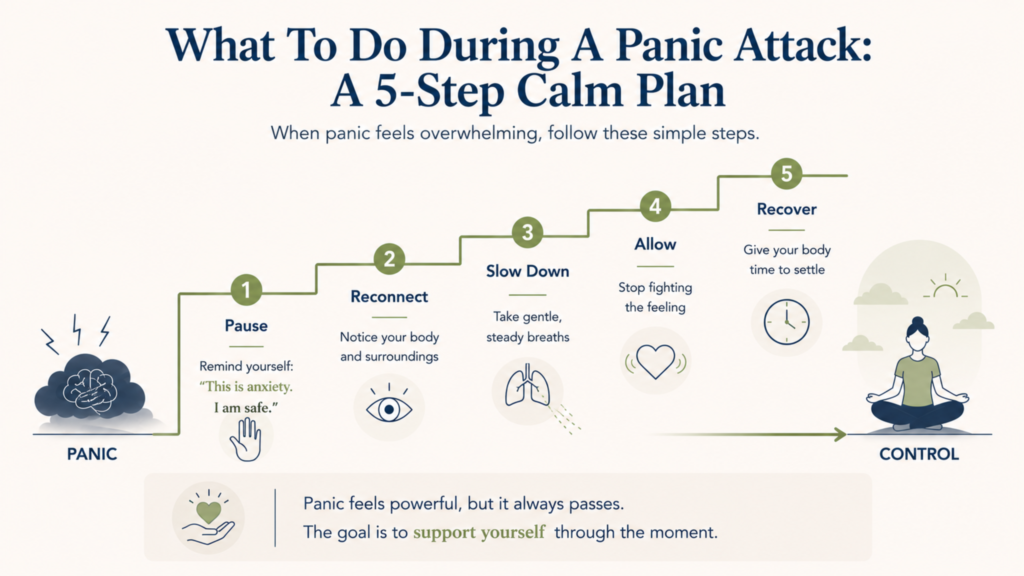
Now that we know what grounding is and how it exactly helps, let’s look at some practical grounding exercises for panic attacks you can try right away.
1. Try the 5 4 3 2 1 grounding technique
One of the most well-known grounding techniques for panic attacks is the 5 4 3 2 1 grounding technique.
Also called 5 senses grounding technique, it uses your five senses to bring your attention back to the present moment.
Here is how it works:
5 things you can see
Look around and notice five things around you. They can be anything, a chair, a window, a plant, a color on the wall.
4 things you can feel
Notice four physical sensations. Maybe your feet touching the floor, your clothing against your skin, or the texture of an object nearby.
3 things you can hear
Pay attention to three sounds. This could be a fan, traffic outside, your breathing, or voices around you.
2 things you can smell
Notice two scents around you. It could be coffee, soap, fresh air, or anything familiar.
1 thing you can taste
Focus on one taste, such as water, a mint, or simply the feeling inside your mouth.
2. Feel your feet on the ground
When panic becomes intense, many people feel disconnected from their body.
Now, one simple way to reconnect with yourself is to focus on your feet touching the ground.
Try to notice:
- The pressure between your feet and the floor
- The temperature beneath you
- The sensation of your shoes or socks
- The feeling of your body being supported
You can even gently press your feet down and remind yourself: ‘I am here, grounded and supported.’
This is one of the easiest grounding techniques for panic attacks because you can do it almost anywhere.
3. Take slow, intentional breaths
Breathing changes during panic. You take quick, shallow breaths, which can make physical anxiety symptoms feel even stronger.
Slow breathing is a somatic healing technique that signals your nervous system that you are not in immediate danger.
Here’s what you can do:
- Slowly breathe in through your nose.
- Hold for a moment.
- Slowly breathe out.
Don’t force yourself to take a perfect breath. Make your breathing slightly slower and more comfortable.
Even a few intentional breaths can help create a small sense of calm.
4. Use calming self-talk
Your thoughts can become frightening during a panic attack. You can get thoughts like:
- I can’t handle this.
- Something bad is happening.
- What if this never stops?
These thoughts make panic feel even more intense.
Calming self-talk helps you respond to those thoughts with kindness and reassurance. For instance, you can remind yourself:
- This feels scary, but I have experienced this before and gotten through it.
- My body is having a stress response. I am safe.
- This feeling will pass.
This does not mean pretending everything is fine. You are simply speaking to yourself the way you would speak to someone you care about.
5. Hold something cold
Strong physical sensations can help redirect your attention when anxiety feels overwhelming.
For instance, holding something cold, like an ice cube, a cold bottle of water, or placing your hands under cool water, can help bring your awareness back to your body.
You can focus on:
- The temperature
- The sensation against your skin
- How the feeling changes over time
This will create a physical anchor that helps pull your attention away from racing thoughts.
6. Describe your surroundings in detail
When panic happens, your mind becomes focused on internal sensations and fears.
A simple grounding technique for panic attacks is to describe what you see around you.
Here, you can try describing your environment like you are explaining it to someone who cannot see it. For instance:
- I am sitting on a blue chair.
- There is a window beside me.
- The walls are white.
- There is sunlight coming through the room.
This encourages your brain to focus on the present rather than the anxious story happening in your mind.
7. Practice mindful movement
Grounding does not always have to involve sitting still. Sometimes, gentle movement can also help you reconnect with your body.
You can try:
- Walking slowly while noticing each step
- Stretching your arms and shoulders
- Rolling your neck gently
- Moving your hands intentionally
The goal is not to exercise but to simply remind yourself: ‘I am connected to my body.’ This is especially helpful when you feel restless or trapped.
8. Name your emotions
A lot of people try to push panic away as quickly as possible. But sometimes, acknowledging what you are feeling can actually reduce its intensity.
For instance, you can name your emotions like:
- I am feeling anxious right now.
- I am feeling scared.
- I am feeling disconnected from my partner
- I am feeling overwhelmed
Naming your emotions helps create some distance between you and the feeling. This helps you feel more in control.
9. Name five things exercise
This is a simpler version of the 5 4 3 2 1 grounding technique. You can simply look around and name five things you notice.
For instance:
- A lamp
- A table
- A book
- A plant
- A window
This might seem simple, but during panic, simple exercises can be powerful. They help your brain move away from fear and toward observation.
10. Create a grounding kit
A grounding kit is a small collection of items you can use when anxiety feels overwhelming. This can include:
- A stress ball
- A comforting scent
- A small textured object
- A calming note to yourself
- A favorite photo
- A reminder of coping strategies that help you
Having these items handy can provide comfort because you know you have something to turn to when panic appears.
11. Focus on the details of one object
When panic feels intense, your mind can become overwhelmed by too many thoughts at once.
One way to create a sense of calm is to choose one object near you and focus on its details. It could be anything like:
- A coffee mug
- A piece of jewelry
- A pen
- A plant
- A piece of fabric
You can try to notice:
- What color is it?
- What texture does it have?
- Does it have patterns or small details you have never noticed before?
This simple exercise helps your brain move from fear and uncertainty toward curiosity and observation.
12. Repeat a grounding phrase
Your thoughts can quickly move toward worst-case scenarios during a panic attack. And in that situation, a grounding phrase can act as a gentle reminder that brings you back to the present.
Some examples of grounding phrases include:
- I am safe in this moment.
- This feeling is uncomfortable, but it will pass.
- My body is experiencing anxiety, and I can handle this.
Now, the goal is not to convince yourself that anxiety does not exist. You are simply creating a calmer inner voice while your nervous system settles.
13. Listen closely to the sounds around you
When anxiety is high, your attention often turns inward. You become focused on:
- Your heartbeat
- Your breathing
- Your thoughts
- Physical sensations
In this case, listening carefully to sounds around you can help shift your attention outward.
You can try noticing:
- The sound of traffic
- Birds outside
- People talking nearby
- The sound of an appliance
- Your own breathing
You can even try closing your eyes and identifying as many different sounds as possible. This is a simple mindfulness grounding exercise that helps remind your brain: ‘I am here in this moment.’
14. Use your sense of smell
Your sense of smell is closely connected with memory and emotions. This is why certain scents can instantly make you feel calm, comfortable, or reminded of a safe place.
During anxiety, you can try using a familiar calming scent such as:
- Lavender
- Coffee
- Essential oils
- A favorite lotion
- Fresh air
Rather than simply smelling the scent, take a moment to notice:
- What does it remind you of?
- How does it make your body feel?
This can help create a feeling of comfort when panic feels overwhelming.
15. Try the categories grounding exercise
This is a mental grounding exercise that gives your brain a simple task to focus on.
You can choose a category and name as many things as you can. For instance:
A. Animals:
- Dog
- Cat
- Horse
- Elephant
B. Cities:
- Denver
- Chicago
- Seattle
- Boston
C. Foods:
- Apples
- Pasta
- Rice
- Salad
The purpose is not to challenge yourself. It is simply to give your mind something neutral and present-focused to focus on.
16. Practice progressive muscle relaxation
Anxiety does not only affect your thoughts. It also affects your body. You might be unknowingly holding tension in your:
- Shoulders
- Jaw
- Hands
- Neck
- Stomach
Now, progressive muscle relaxation involves gently tightening and releasing different muscle groups. For instance:
- Tighten your shoulders for a few seconds.
- Notice the tension.
- Release and relax.
Then move to another area of your body.
This helps you become aware of physical tension and teaches your body what relaxation feels like.
17. Ground yourself through gratitude
When you are experiencing panic, your brain naturally focuses on threats.
A small gratitude exercise can help shift your attention toward safety and comfort.
You can try naming:
- Three things you appreciate
- Three people who support you
- Three things that bring you comfort
This does not mean ignoring anxiety. Your brain is just noticing that fear is not the only thing happening in the present moment.
18. Create a safe place visualization
Sometimes, grounding can happen through your imagination.
Think about a place where you feel calm and safe. It could be:
- A beach
- A childhood memory
- A favorite room
- A place in nature
Also, imagine the details like:
- What do you see?
- What sounds do you hear?
- What does the air feel like?
- What emotions come up?
This safe place visualization technique can be especially helpful when you cannot physically leave a stressful situation.
19. Practice grounding before panic happens
Grounding techniques for panic attacks become more effective with practice.
Many people wait until they are already experiencing intense panic before trying grounding exercises.
But grounding is a skill. And like any skill, it becomes easier when you practice regularly.
You might spend a few minutes each day practicing:
- Mindful breathing
- 5 4 3 2 1 grounding technique
- Body awareness
- Relaxation exercises
That way, when anxiety appears, grounding techniques will feel familiar.
In short, here are the grounding techniques for panic attacks you can use to calm yourself:
| Grounding Technique | How It Helps |
| 5 4 3 2 1 grounding technique | Uses your senses to bring you back to the present moment |
| Feel your feet on the ground | Helps you reconnect with your body and feel supported |
| Slow breathing | Calms your nervous system and reduces physical anxiety symptoms |
| Calming self-talk | Replaces fearful thoughts with reassurance |
| Hold something cold | Creates a strong physical focus during panic |
| Describe your surroundings | Shifts attention away from anxious thoughts |
| Mindful movement | Helps release tension and reconnect with your body |
| Name your emotions | Creates distance between you and overwhelming feelings |
| Name five things around you | Redirects your mind toward the present |
| Create a grounding kit | Gives you comforting tools during difficult moments |
| Focus on one object | Encourages curiosity and reduces mental overwhelm |
| Repeat a grounding phrase | Reminds you that you are safe and can handle the moment |
| Listen to sounds around you | Moves attention away from internal anxiety sensations |
| Use calming scents | Creates comfort through sensory awareness |
| Categories exercise | Gives your mind a neutral task to focus on |
| Progressive muscle relaxation | Releases physical tension stored in the body |
| Gratitude exercise | Helps shift attention toward safety and positive experiences |
| Safe place visualization | Creates a calming mental space during distress |
| Practice grounding regularly | Makes techniques easier to use during future panic attacks |
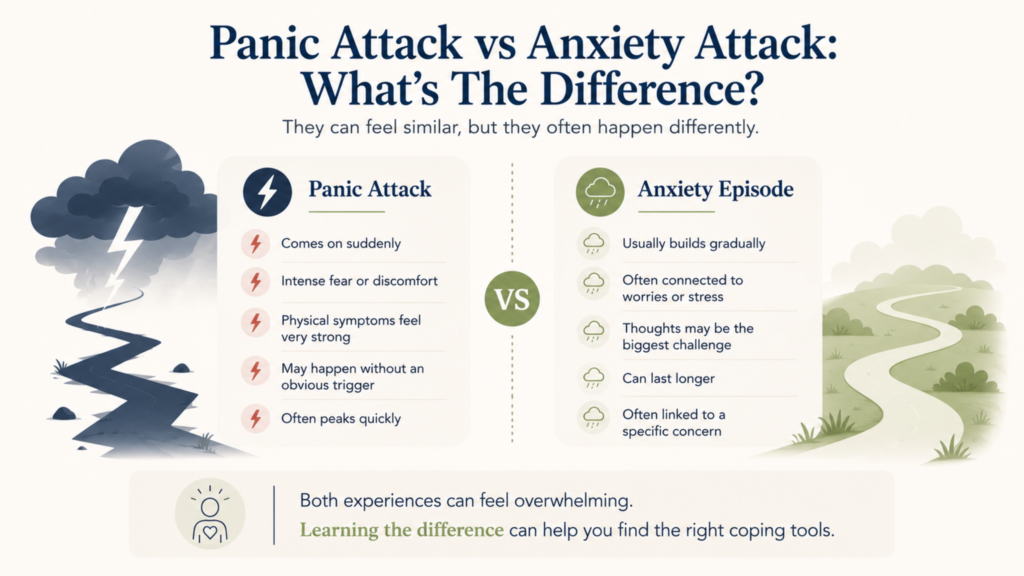
Bonus: Here are some grounding exercises for anxiety at work
Work can be a major source of stress. Deadlines, pressure, difficult conversations, and feeling overwhelmed can all trigger anxiety.
Now, the challenge is that you might not always be able to step away from your responsibilities.
So, here are some grounding exercises for anxiety at work you can try:
| Grounding Exercise | How to Do It at Work |
| Notice Your Surroundings | Look around your workspace and identify 5 things you can see, 3 sounds you can hear, and 1 physical sensation you can feel. You can do this quietly without leaving your desk. |
| Focus on Your Breathing | Take a few slow breaths before replying to a stressful email or joining a difficult conversation. This creates a pause and helps you respond calmly. |
| Feel Your Feet on the Ground | Notice the support beneath you while sitting at your desk. Remind yourself: ‘I am here. I can handle this moment.’ |
When should you seek therapy for panic attacks?
Grounding techniques for panic attacks can be powerful tools for managing anxiety in the moment.
However, if panic attacks are happening frequently, affecting your relationships, or interfering with work, it might be time to seek therapy.
people wait until anxiety becomes unbearable before reaching out.
But therapy is not only for moments of crisis. It can also help you understand:
- What triggers your panic attacks
- Why your nervous system responds this way
- How to develop healthier coping strategies
- How past experiences influence your anxiety today
A therapist can help you explore the deeper causes behind panic and create a plan for moving forward.
As a licensed Denver therapist, I help you process stress, anxiety, and past trauma in a safe, grounded space.
To sum up
Experiencing a panic attack can be frightening. When your body feels like it is in danger and your thoughts start moving fast, it can leave you wondering what’s happening and whether you will ever feel normal again.
But as we saw, panic attacks are your body’s response to a perceived threat. And while the experience can feel overwhelming, there are ways to help yourself feel more grounded and connected in those moments.
Grounding techniques for panic attacks bring your attention back to the present.
Whether it is 5 4 3 2 1 grounding technique, focusing on your breathing, noticing your surroundings, or calming self-talk, these small practices help you create a sense of stability.
Got more questions or looking for anxiety therapy in Denver?
You can get in touch with me!
At 12:2 Counseling, I work with individuals who are experiencing anxiety, panic attacks, emotional overwhelm, and relationship challenges.
Together, we’ll explore what might be contributing to your anxiety and develop practical strategies to help you feel more grounded, confident, and connected with yourself.
I offer in-person therapy in Denver and virtual sessions across Colorado.
FAQs about grounding techniques for panic attacks
What is a grounding technique for anxiety?
A grounding technique is a strategy that helps bring your attention back to the present moment when anxiety, panic, or overwhelming thoughts take over.
Grounding exercises use your senses, body awareness, breathing, or mindful attention to help you reconnect with what is happening around you.
What is the fastest grounding technique for panic attacks?
One of the most commonly used techniques for panic attacks is the 5 4 3 2 1 grounding technique.
This exercise uses your five senses to help redirect your attention:
- Five things you can see
- Four things you can feel
- Three things you can hear
- Two things you can smell
- One thing you can taste
Does the 5 4 3 2 1 grounding technique work for anxiety?
The 5 4 3 2 1 grounding technique can be helpful for many people experiencing anxiety because it shifts attention away from overwhelming thoughts and toward the present moment.
How do you ground yourself during anxiety?
You can ground yourself during anxiety by focusing your attention on the present moment rather than getting pulled into fearful thoughts.
Some ways to do this include:
- Taking slow breaths
- Feeling your feet on the floor
- Naming objects around you
- Using the 5 4 3 2 1 grounding technique
- Practicing calming self-talk
- Paying attention to physical sensations
Can grounding exercises stop a panic attack?
Grounding exercises can help reduce the intensity of a panic attack by helping you reconnect with the present moment and feel more in control.
However, grounding does not always make panic disappear immediately. For instance, if you get panicked because of agoraphobia or social anxiety, grounding will help you feel at ease, but it will not eliminate the underlying reason that is causing panic.
Think of grounding as a tool that helps you move through the experience with more calm and awareness.
What are some grounding exercises for anxiety at work?
Some grounding exercises for anxiety at work include:
- Taking a few slow, intentional breaths before responding to stressful situations
- Feeling your feet on the ground while sitting at your desk
- Naming objects you see around your workspace
- Taking a short mindful break to notice your surroundings
Can grounding exercises help relationship anxiety?
Yes, grounding exercises can be helpful for relationship anxiety because they can help you separate anxious thoughts from what is actually happening in the present moment.
For instance, if you notice yourself worrying about whether your partner is upset or whether something is wrong, grounding can help you pause.
How long does a panic attack usually last?
Panic attacks often feel much longer than they actually are.
While the most intense symptoms might peak within several minutes, the physical and emotional effects can sometimes continue longer as your body returns to a calmer state.
When should I seek therapy for panic attacks?
You should seek therapy if panic attacks:
- Happen frequently
- Cause you to avoid certain situations
- Affect your work or relationships
- Make you constantly worry about having another attack
- Feel difficult to manage on your own
Can panic attacks be treated?
Yes.
People learn to manage and reduce panic attacks with the right support and coping strategies.
Treatment approaches include learning about anxiety, developing healthier thought patterns, practicing emotional regulation skills, and exploring underlying experiences that contribute to panic.
Licensed Professional Counselor Candidate , MA, LPCC
Kim Hernandez is founder of 12:2 Counseling in Denver, helping individuals address trauma, anxiety, addiction-related patterns, and burnout through EMDR, somatic therapy, CBT, and compassionate body-mind-spirit care that supports steadier relationships, emotional freedom, and lasting change forward.