What Is Somatic Therapy And What Somatic Healing Techniques Do Therapists Use In Denver?

Written By
Kim Hernandez

Ever noticed your body reacting to stress before you even realize you’re stressed?
Maybe your shoulders tense up during difficult conversations, your heart starts racing before a stressful event, and you feel exhausted or restless even when everything seems fine.
You see, for a long time, therapy focused only on thoughts, emotions, and experiences. And while these help, therapists are now recognizing that stress and trauma can also affect your body.
This is where somatic therapy becomes helpful.
For starters, somatic therapy is a body-focused therapy that helps you become more aware of the connection between their physical sensations, emotions, and experiences.
Here, instead of focusing only on past experiences or what you think about them, somatic therapy explores what happens in your body when certain memories come up.
The goal isn’t to force yourself to relive difficult experiences but to help you develop awareness of your body’s responses and learn healthier ways to respond.
Now, I am sure you’re curious what is somatic therapy really and how it can help you. So, read on to know:
- What somatic therapy is and how it works
- The somatic healing techniques therapists use in Denver
- How somatic therapy helps with trauma, anxiety, and stress
- What happens during a somatic therapy session
- Whether or somatic therapy is right for you
Key takeaways
- Somatic therapy is a type of psychotherapy that focuses on the connection between the mind and body.
- It helps people become more aware of physical sensations connected to emotions, stress, and past experiences.
- Somatic therapy can be helpful for trauma, anxiety, chronic stress, and emotional regulation.
- Common somatic techniques include grounding exercises, breathwork, body awareness, movement, and nervous system regulation practices.
- Somatic therapy does not replace traditional talk therapy but offers an alternative to process difficult experiences.
What is somatic therapy?

To begin with, somatic therapy is a form of psychotherapy that focuses on the relationship between your mind and your body. Here, the word somatic comes from the Greek word soma, meaning body.
The therapy helps you pay attention to physical sensations, emotions, and patterns in your body to better understand and manage your experiences.
You see, our thoughts and emotions don’t exist separately from our bodies.
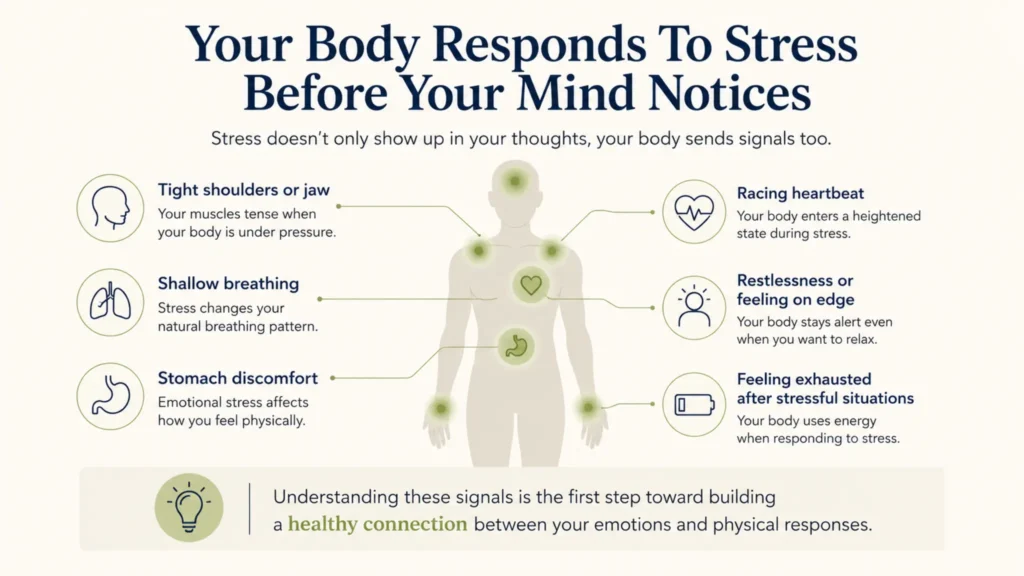
Think about the last time you felt anxious. I am sure you also noticed physical sensations like:
- Your heart beating faster
- Your breathing becoming shallow
- Your muscles tightening
- Feeling restless or unable to relax
These are your body’s way of responding to emotional experiences.
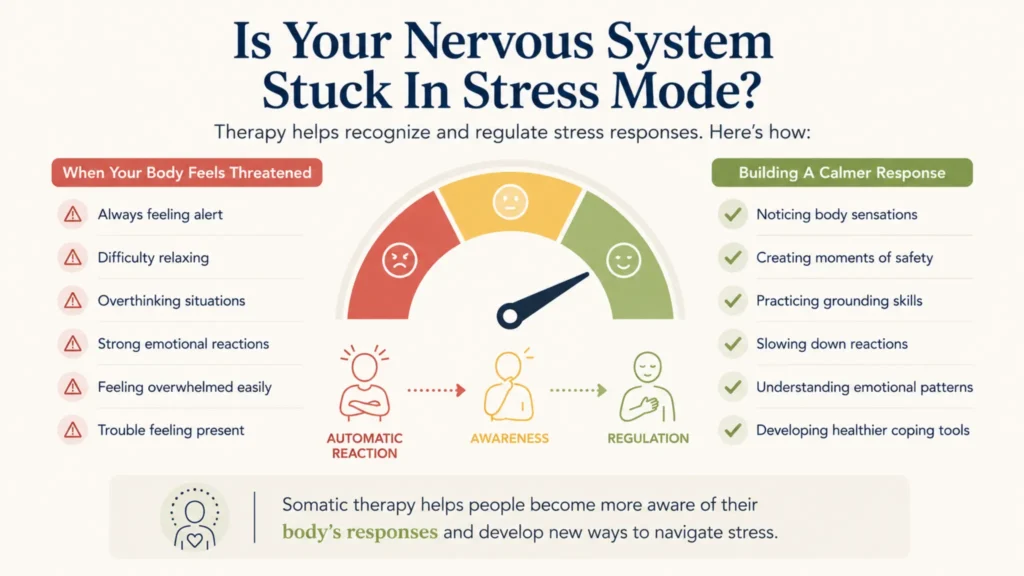
Now, let’s say you’ve been through repeated periods of stress, fear, or overwhelming experiences.
In this case, even after the situation has passed, your body might continue responding as if it needs to stay alert. That’s because your body has learned certain patterns in response to your experiences.
Somatic therapy helps you notice these patterns and develop healthy ways to respond.
How are somatic healing techniques different from traditional talk therapy?
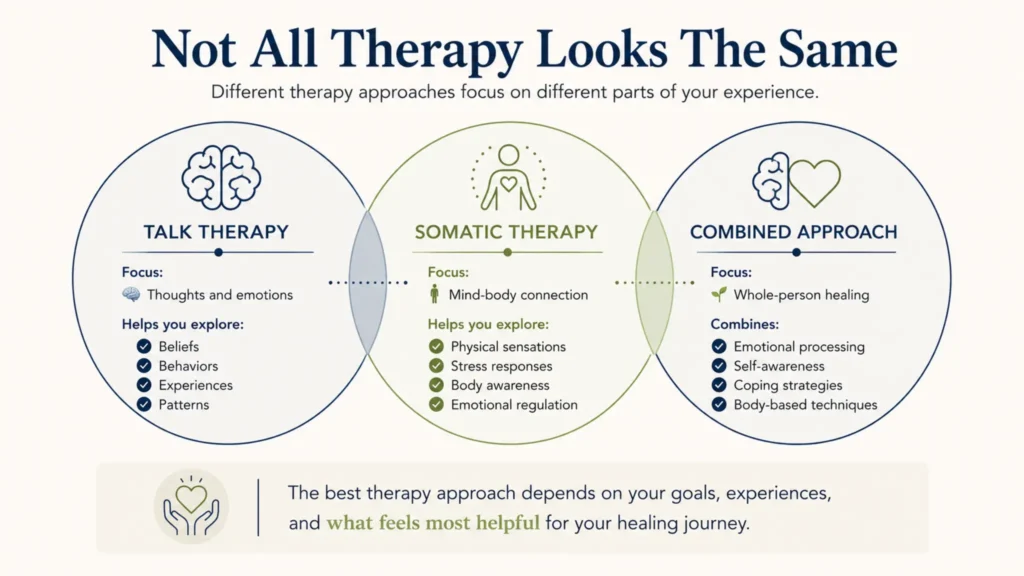
The biggest difference between somatic and traditional talk therapy is where the therapist places attention.
Traditional therapy in Denver focuses on:
- Thoughts
- Beliefs
- Behaviors
- Emotions
- Life experiences
Somatic therapy includes those things but also explores:
- Physical sensations
- Body responses
- Breathing patterns
- Nervous system responses
- How you experience emotions physically
For instance, if you feel anxious before speaking in front of others, traditional therapy will focus on:
- What thoughts are creating anxiety?
- What beliefs do you have about failure?
- How can you challenge those thoughts?
Somatic therapy will go a step ahead to explore:
- Where do you notice anxiety in your body?
- Does your chest feel tight?
- Does your breathing change?
- What happens when you slow down and notice that sensation?
The idea is that being aware of these physical responses will help you manage overwhelming emotions better and feel more grounded.
As a licensed Denver therapist, I help you process stress, anxiety, and past trauma in a safe, grounded space.

Who can benefit from somatic therapy in Denver?
Somatic therapy is helpful for people who feel affected by difficult experiences both emotionally and physically.
In fact, therapists in Denver use it as part of therapy for:
- Trauma and PTSD
- Anxiety
- Chronic stress
- Emotional overwhelm
- Grief
- Relationship challenges like feeling disconnected from your partner
- Feeling disconnected from yourself or your body
However, you need not have experienced a traumatic event to try somatic therapy. You can also try it if you want to better understand your stress responses, feel more connected to yourself, and learn healthier ways to cope with difficult emotions.
How does somatic therapy work in Denver?

While traditional therapy focuses on talking through thoughts, emotions, and experiences, somatic therapy is a body-focused approach.
The basic idea behind somatic therapy is that your body can provide important information about your emotional experiences.
For instance, when you’re stressed, your body reacts before you consciously process what you’re feeling. You might notice tensed up muscles, faster breathing, increased heart rate, and an urge to escape a situation.
Somatic therapy helps you slow down and become aware of these reactions instead of being controlled by them. Here, a therapist will help you notice:
- Where you feel certain emotions in your body
- How your body responds to specific thoughts or memories
- What sensations feel comfortable or uncomfortable
- How you can create a greater sense of safety and calm
For someone experiencing trauma, this can be especially helpful because traumatic experiences continue influencing how the body responds to stress.
What somatic healing techniques do therapists use in Denver?
Therapists use different approaches depending on your goals, experiences, and comfort level. This includes body awareness, grounding exercises, movement, breathing techniques, or processing difficult experiences.
Here are some common somatic healing techniques common in Denver:
1. Body awareness and body scanning
Body awareness focuses on noticing what’s happening inside your body.
Here, your therapist will guide you to pay attention to physical sensations such as:
- Muscle tension
- Changes in breathing
- Areas of discomfort
- Feelings of warmth or heaviness
- Places where your body feels relaxed
For instance, you might notice tightness in your chest or shoulders when discussing a stressful experience.
Now, rather than ignoring these sensations, somatic therapy encourages curiosity. This helps you understand what your body is communicating and learn how to respond differently.
2. Grounding exercises
Grounding techniques are commonly used in somatic therapy for anxiety and trauma because they help you reconnect with the present moment.
You see, when you feel overwhelmed, anxious, or triggered, you can be disconnected from what is happening around.
Grounding exercises for panic attacks help bring attention back to the moment through exercises like:
- Noticing sensations through your feet on the floor
- Paying attention to objects around you
- Taking slow, intentional breaths
- Identifying sounds, colors, or textures around you
These techniques can help create a greater sense of stability during emotionally challenging moments.
3. Breathwork
When you feel anxious or overwhelmed, your breathing changes. You might breathe faster, hold your breath, or take shallow breaths.
Somatic therapists use gentle breathing exercises to help you become more aware of your breathing patterns and develop calming responses.
The goal here is to learn how your breathing affects your emotional state and use that awareness as a tool.
4. Movement and mindful physical exercises
Some emotions and stress responses can show up through physical patterns in your body. This is why somatic therapy also uses gentle movements like:
- Stretching
- Slow movements
- Changes in posture
- Noticing how different movements feel
For instance, someone who feels tense or guarded might notice what happens when they intentionally relax certain areas of the body.
5. Pendulation
Pendulation is a technique common in somatic therapy. Here, instead of staying focused on overwhelming emotions, you learn to move between difficult sensations and more comfortable ones.
For instance, a therapist might help you notice a stressful feeling and then shift your attention toward something that feels safe or calming.
This creates a sense that difficult emotions can be experienced without becoming completely overwhelming.
6. Resourcing
Resourcing involves identifying things that help you feel safe, calm, or supported.
A resource can be different for everyone and it can include:
- A supportive person
- A positive memory
- A peaceful place
- A comforting activity
- A personal strength
During therapy, focusing on these resources can help create a stronger foundation before moving to difficult emotions or experiences.
7. Titration
Titration is another technique commonly used in trauma-focused somatic therapy in Denver. It involves approaching difficult emotions or memories slowly rather than experiencing everything at once.
Think of it like adjusting the volume on a speaker. Instead of turning the volume all the way up, you slowly increase it while staying aware of your ability to cope.
This approach helps people process difficult experiences at a pace that feels manageable.
In short, here are some common somatic healing techniques used across Denver:
| Technique | How it helps |
| Body awareness | Helps you notice physical sensations connected to emotions |
| Grounding exercises | Helps you reconnect with the present moment during stress |
| Breathwork | Builds awareness of breathing patterns and relaxation responses |
| Mindful movement | Helps improve connection between physical sensations and emotions |
| Pendulation | Helps move between difficult emotions and feelings of safety |
| Resourcing | Builds awareness of things that create comfort and stability |
| Titration | Helps process difficult experiences gradually |
What are the benefits of somatic therapy?
Now that you know what is somatic therapy and what somatic approaches are used in Denver, let’s talk about its benefits.
At its basic, somatic therapy helps you better understand yourself, manage stress, and develop healthier ways of responding to life’s challenges.
Here, as therapy progresses, you become more aware of the connection between your body and emotions. Also, you begin to notice patterns that were previously difficult to recognize.
For instance, you might understand why certain situations trigger strong reactions, why stress shows up physically, or why relaxing feels difficult even when life is going well.
Over time, somatic therapy helps you:
- Feel more connected to your body
- Recognize stress responses earlier
- Develop healthier coping strategies
- Feel more grounded during difficult moments
- Improve emotional awareness
- Build resilience after stressful experiences
For people dealing with trauma, anxiety, or chronic stress, this awareness is an important part of healing.
Overall, here are some common benefits people experience after somatic therapy in Denver:
| Benefit | How it helps |
| Greater self-awareness | Helps you recognize emotional and physical patterns |
| Better stress management | Helps you respond to stress more intentionally |
| Improved emotional regulation | Makes intense emotions easier to navigate |
| Increased sense of calm | Builds skills for feeling more grounded |
| Stronger mind-body connection | Helps you better understand your own responses |
What happens during a somatic therapy session?
People imagine that because somatic therapy focuses on the body, it involves intense physical exercises or something completely different from traditional therapy.
But that’s usually not true.
Somatic therapy sessions still involve conversation. You’ll talk with your therapist about your experiences, emotions, challenges, and goals.
The difference is that your therapist might also help you pay attention to what’s happening in your body as you talk.
For instance, while discussing a stressful situation, your therapist might ask questions like:
- What are you noticing in your body right now?
- Where do you feel that emotion physically?
- Does anything change when you slow down and take a breath?
- What happens when you focus on a feeling of safety or comfort?
The goal is to develop a better understanding of how your thoughts, emotions, and body responses are connected.
Depending on your needs, a somatic therapy session in Denver can include:
- Talking through current challenges
- Exploring physical responses connected to emotions
- Practicing grounding techniques
- Learning breathing exercises
- Building awareness of stress patterns
- Developing healthier ways to respond to overwhelming feelings
How is somatic therapy different from trauma therapy?
The main difference is the focus of therapy.
Traditional trauma therapies focuses heavily on:
- Understanding your memories
- Processing thoughts connected to the experience
- Changing beliefs about what happened
- Developing coping strategies
Somatic approaches add another layer by exploring how those experiences show up physically. It helps understand the connection between emotional experience and your body’s response to it.
It does not replace traditional trauma therapy. In fact, many therapists use somatic techniques alongside other therapy methods.
Bonus: Here’s when somatic therapy can be helpful for you
| Your experience/feeling | How somatic therapy helps |
| Feeling overwhelmed by stress | Helps you recognize and respond to body signals |
| Anxiety or constant tension | Builds awareness of physical stress responses |
| Difficulty processing emotions | Creates another way to explore emotional experiences |
| Feeling disconnected from yourself | Strengthens mind-body awareness |
| Past stressful experiences | Helps explore how those experiences continue affecting you |
You might also want to read: How To Find A Therapist In Denver, CO?
As a licensed Denver therapist, I help you process stress, anxiety, and past trauma in a safe, grounded space.
To sum up
I am sure that you now have a clear idea about what is somatic therapy and how therapists in Denver use it.
As you can see, somatic therapy is a mind-body therapy approach that helps you understand the connection between your physical sensations, emotions, and experiences.
Rather than focusing only on thoughts or memories, it explores how stress and emotions show up in your body.
This approach is especially helpful if you understand your experiences mentally but still struggle with physical reactions such as tension, anxiety, or feeling overwhelmed.
Looking for somatic therapy in Denver?
You can get in touch with me!
At 12:2 Counseling, I work with people dealing with trauma, anxiety, stress, emotional overwhelm, and life transitions.
I use evidence-based approaches tailored to your needs, including trauma-informed methods that help you better understand your experiences, build emotional resilience, and feel more grounded.
My sessions are available in-person in Denver and virtually across Colorado.
FAQs about somatic therapy
What is somatic therapy?
Somatic therapy is a form of psychotherapy that focuses on the connection between the mind and body. It helps people become more aware of physical sensations, emotions, and patterns connected to stress, trauma, anxiety, and other experiences.
Unlike traditional talk therapy that focuses mainly on thoughts and emotions, somatic therapy also explores how experiences show up physically in the body.
How does somatic therapy work?
Somatic therapy works by helping people develop awareness of the connection between their emotions and physical sensations.
During sessions, a therapist might guide you through body awareness exercises, grounding techniques, breathing practices, and other approaches to help you recognize and respond to stress patterns in healthier ways.
What somatic healing techniques do therapists use in Denver?
Common somatic healing techniques include body awareness, grounding exercises, breathwork, mindful movement, resourcing, pendulation, and titration.
These techniques help clients notice physical responses connected to emotions and develop strategies for feeling more regulated and grounded.
Can somatic therapy help with trauma?
Yes, somatic therapy can be helpful for people processing trauma and stressful experiences.
It focuses on understanding how difficult experiences might continue influencing emotional and physical responses. Many therapists use somatic techniques alongside other trauma-focused approaches based on each person’s needs.
Is somatic therapy good for anxiety?
Somatic therapy can be helpful for some people experiencing anxiety because it focuses on recognizing physical stress responses and developing tools to feel more grounded.
Techniques such as breathing exercises, body awareness, and grounding practices might help people better understand and manage their reactions to anxiety.
What happens in a somatic therapy session?
A somatic therapy session usually involves conversation along with body-focused awareness exercises.
Your therapist will help you notice physical sensations, explore emotional patterns, practice grounding techniques, and develop healthier ways to respond to stress or difficult experiences.
Licensed Professional Counselor Candidate , MA, LPCC
Kim Hernandez is founder of 12:2 Counseling in Denver, helping individuals address trauma, anxiety, addiction-related patterns, and burnout through EMDR, somatic therapy, CBT, and compassionate body-mind-spirit care that supports steadier relationships, emotional freedom, and lasting change forward.