What Does Dissociation Look Like? 5 Warning Signs You Should Never Ignore

Written By
Kim Hernandez

A lot of my clients I talk to have always believed that dissociation happens only to people with severe trauma or a dissociative disorder.
But that’s not true at all.
In reality, almost everyone experiences mild dissociation from time to time. For instance, you might be so absorbed in a movie that you lose track of time, or maybe you come home driving without remembering much of the journey.
And while this is normal, the problem starts when dissociation goes beyond occasional daydreaming. You might suddenly feel disconnected from yourself, like you’re watching your life from the outside instead of actually living it.
People even lose track of time, struggle to remember parts of their day, or feel emotionally numb even during situations that would normally bring up strong feelings.
Thankfully, it is possible to feel grounded and in control again once you know why it happens.
In this blog, I will explain it all, including:
- What it means to dissociate
- What does dissociation look like in daily life
- Five warning signs of dissociation
- Grounding techniques to stop dissociating
- And a lot more
So, let’s get into it.
Key takeaways
- Dissociation is a coping response where you feel disconnected from yourself, your emotions, your memories, or your surroundings.
- Mild dissociation is common, but frequent or intense episodes might signal an underlying mental health concern.
- Common signs include feeling detached from yourself, losing track of time, numbness, and operating on autopilot.
- Dissociation is linked to trauma, anxiety, chronic stress, or emotional overwhelm.
- Therapy can help you understand what’s causing dissociation and teach healthy ways to manage it.
What is dissociation?

Dissociation is a mental process where you feel disconnected from yourself, your thoughts, your emotions, your memories, or the world around you. You might even start feeling disconnected from your partner or loved ones.
Here, your mind temporarily creates distance between you and your experience. And this happens during highly stressful situations, after trauma, during periods of intense anxiety, or when you’re emotionally overwhelmed.
But why does it happen?
Well, your brain has an emergency protective mode. So, whenever something feels too distressing to process, your mind distances itself from it to reduce the emotional impact.
This is why dissociation is seen as a coping mechanism rather than a conscious choice.
Now, not everyone who dissociates has experienced severe trauma. Stress, burnout, panic attacks, and even prolonged emotional exhaustion can cause one to dissociate.
As a licensed Denver therapist, I help you process stress, anxiety, and past trauma in a safe, grounded space.

Here’s a simple way to understand emotional dissociation:
| Experience | What it feels like |
| Mild dissociation | Daydreaming, getting lost in a book, or forgetting part of your drive home |
| Major dissociation | Feeling disconnected from yourself, emotionally numb, or like your surroundings aren’t real |
Therapist’s tip: Dissociation exists on a spectrum. Occasional, mild episodes are common. But if it becomes frequent, lasts for long periods, or starts interfering with your work, relationships, or daily life, it needs close attention.
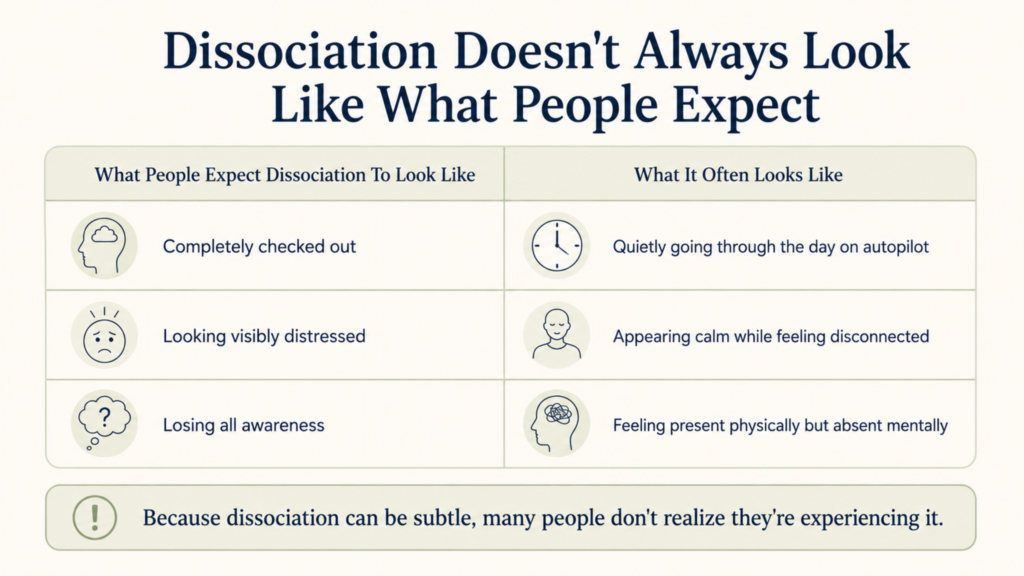
What does dissociation look like? 5 Signs you should pay attention to

Dissociation doesn’t always look dramatic. One might appear completely calm on the outside while feeling deeply disconnected on the inside.
You might still go to work, have conversations, or finish everyday tasks. But from within, it can feel as if you’re moving through life on autopilot.
For instance, you might:
- Read the same paragraph several times without remembering what it said.
- Drive somewhere and realize you don’t remember most of the journey.
- Feel emotionally flat even during important moments.
- Suddenly realize you’ve lost track of time.
- Feel like you’re observing yourself instead of actually experiencing life.
These experiences can happen occasionally during periods of stress. However, if they become more frequent, start affecting your daily life, or cause work avoidance, it’s a sign that your mind is struggling to cope with something deeper.
Overall, here are five warning signs of dissociation you should never ignore:
1. Feeling disconnected from yourself
The most common sign of dissociation is feeling disconnected from yourself.
You might feel like you’re watching yourself from outside instead of fully experiencing what’s happening. People also describe it as feeling like they’re on autopilot or as if they’re observing their life rather than living it.
For instance, you might look in the mirror and briefly feel like the person looking back doesn’t quite feel like you. Or you might hear yourself talking in a conversation but feel strangely detached from your own words.
This is also called depersonalization. And while it can feel frightening, it doesn’t mean you’re losing control. It is a way your brain tries to create emotional distance during periods of overwhelming stress or anxiety.
2. Feeling like the world around you isn’t real
Sometimes, you disconnect from your surroundings. You suddenly feel like the world looks dreamlike, foggy, distant, or somehow different, even though nothing has actually changed.
For instance, familiar places suddenly feel unfamiliar, colors seem dull or unusually bright, or people around you seem strangely distant, almost as if you’re watching them through a window.
This is called derealization. Even though you know the world is real, it doesn’t feel real in that moment.
People experience derealization during periods of intense anxiety, panic attacks, or overwhelming stress. And since it feels so unusual, it increases anxiety, creating a cycle where the fear makes the dissociation feel even stronger.
3. Losing track of time or having unexplained memory gaps
Another warning sign of dissociation is gaps in your memory.
This doesn’t mean forgetting major life events. More commonly, you realize that you don’t remember parts of your day or wonder where the last hour went.
For instance, you might:
- Finish driving without remembering the trip.
- Walk into a room with no idea why you went there.
- Suddenly realize you’ve been staring into space for minutes.
- Struggle to remember parts of a conversation from earlier in the day.
Therapist’s tip: Occasional lapses in attention can happen to anyone. But if you regularly lose track of time or experience memory gaps that interfere with daily life, I strongly suggest you talk to a mental health professional.
4. Feeling emotionally numb
For some people, dissociation also looks like emotional numbness. Here, instead of feeling sad, happy, excited, or frustrated, you feel nothing.
You know something important has happened, but your emotional response doesn’t seem to match the situation.
For instance, you might:
- Feel disconnected during an important conversation.
- Have difficulty crying even when you want to.
- Feel emotionally flat after a stressful event.
- Notice that things you once enjoyed no longer bring much emotion.
This type of emotional dissociation can sometimes make you wonder whether you’ve become uncaring.
In reality, emotional numbness is your brain’s way of reducing emotional pain when life feels overwhelming.
5. Feeling mentally absent even while functioning normally
One of the reasons dissociation is so difficult to recognize is that you still appear completely functional. You go to work, answer emails, attend meetings, and have conversations, all while feeling mentally disconnected the entire time.
Inside, however, it can feel like you’re simply going through the motions.
Some people also experience dissociative absorption, where they become so deeply absorbed in their thoughts that they lose awareness of what’s happening around them.
For instance, someone calls your name several times before you realize they’re speaking to you, or you become so immersed in your thoughts that you lose awareness of time passing.
While mild absorption is a normal part of everyday life, frequent episodes combined with other signs of dissociation indicate that your mind is trying to cope with stress or overload.
In short, here’s what does dissociation look like:
| Sign of dissociation | What it looks like |
| Feeling disconnected from yourself | You feel like you’re watching yourself from the outside |
| Feeling like the world isn’t real | Your surroundings seem dreamlike, distant, or unreal |
| Memory gaps or losing track of time | You forget parts of your day or wondering where time went |
| Emotional numbness | You feel detached from your emotions or unable to connect with them |
| Functioning on autopilot | You complete daily tasks while feeling mentally absent |
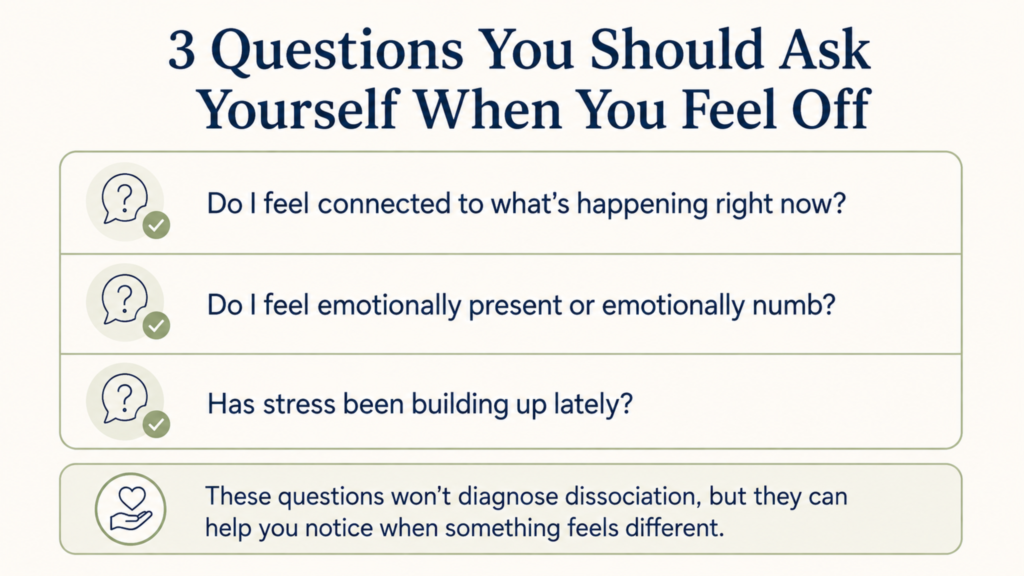
Why does dissociation happen?
Dissociation is your brain’s way of protecting you when something feels emotionally overwhelming.
You see, when your mind believes that a situation is too stressful, frightening, or emotionally painful, it temporarily disconnects from the experience to make it feel more manageable.
You’re still experiencing the situation. But your brain creates some emotional distance from it.
Some of the most common reasons people dissociate include:
- Trauma or adverse childhood experiences
- Anxiety, panic, or nervous system dysregulation
- Chronic stress
- Burnout and emotional exhaustion
- Depression
- Overwhelming life events
Dissociation can also show up in the middle of an emotional flashback.
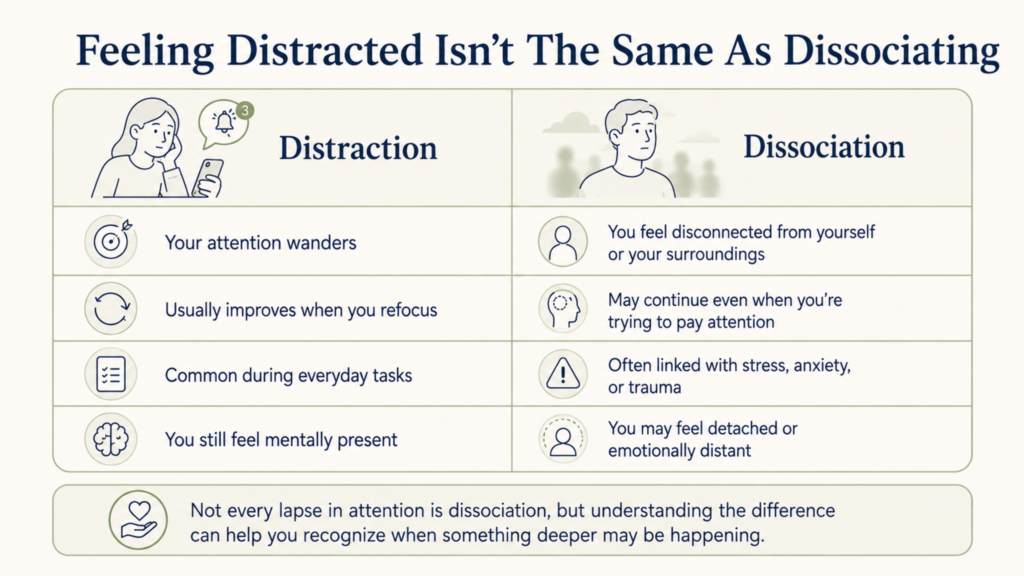
How to stop dissociating? 3 Grounding techniques for dissociation you can try right now
Since dissociation is an automatic response, you can’t simply stop it or snap out of it by simply trying harder. So, you should try to gently reconnect with the present moment without overwhelming yourself further.
Here are some grounding techniques for dissociation that you can try right away:
1. Use your senses to reconnect with the present
One of the quickest ways to interrupt dissociation is to focus on what’s happening around you right now.
You can try the 5 senses grounding technique, one of several grounding techniques for panic attacks, where you will:
- Name five things you can see.
- Notice four things you can touch.
- Listen for three different sounds.
- Identify two things you can smell.
- Notice one thing you can taste.
This simple exercise helps shift your attention away from the feeling of disconnection and back to your surroundings.
2. Move your body
Gentle movement also helps you feel more present. You can take a short walk, stretch your muscles, hold a cold glass of water, or place both feet firmly on the floor.
You aren’t doing a full fledged exercise. You are simply reminding your brain that you’re safe and connected to your body in the present moment.
3. Identify what’s triggering the dissociation
Dissociation happens for a reason, even if that reason isn’t immediately obvious.
So, do ask yourself:
- Have I been under a lot of stress lately?
- Am I feeling overwhelmed?
- Did something happen that made me anxious?
- Am I dissociated because of an underlying attachment wound?
- Am I emotionally exhausted?
Understanding your triggers can make it easier to recognize patterns and respond before dissociation becomes more intense.
When should you talk to a therapist?
You should talk to a therapist if dissociation:
- Happens frequently.
- Lasts for long periods of time.
- Interferes with work, school, or relationships.
- Causes significant memory gaps.
- Makes you feel unsafe or disconnected from reality.
- Occurs after a traumatic experience.
Therapy can help you understand why you’re dissociating, identify the situations that trigger it, and develop healthier ways to manage stress and difficult emotions.
Depending on what’s contributing to dissociation, approaches like cognitive behavioral therapy and other trauma-informed therapies can reduce dissociation and help you feel more grounded.
As a licensed Denver therapist, I help you process stress, anxiety, and past trauma in a safe, grounded space.
To sum up
I am sure you now have a much clear picture of what does dissociation look like in everyday situations. And as you can see, dissociation is much more common than people realize.
While mild dissociation can happen to almost anyone, frequent or intense episodes can be your mind’s way of responding to anxiety, chronic stress, burnout, or unresolved trauma.
So don’t ignore the signs. If you regularly feel disconnected from yourself, lose track of time, feel emotionally numb, or experience the world as unreal, talk to a therapist and understand the root cause.
Got more questions about emotional dissociation or looking for a therapist in Denver?
You can get in touch with me!
I am a licensed therapist in Colorado specializing in work with high-functioning adults navigating anxiety, trauma, chronic stress, burnout, and dissociation.
I use evidence-based approaches like CBT and EMDR to help clients better understand the patterns behind their symptoms, process difficult experiences, and develop practical tools to feel grounded.
My therapy sessions are available in person in Denver and virtually throughout Colorado. If dissociation is tied to unresolved trauma, PTSD therapy in Denver may be the right starting point.
FAQs about dissociation
What is dissociation?
Dissociation is a mental process where you feel disconnected from your thoughts, emotions, memories, body, or surroundings. It happens as a way for the brain to cope with overwhelming stress, anxiety, or traumatic experiences.
What does it mean to dissociate?
To dissociate means to temporarily lose your usual sense of connection with yourself or your environment. Some people feel emotionally numb, while others feel detached from their body, experience memory gaps, or feel like the world around them isn’t real.
How long does dissociation last?
The length of dissociation varies from person to person.
For some people, it lasts only a few seconds or minutes. For others, it can continue for several hours or longer, especially if it’s related to ongoing stress, anxiety, trauma, or a dissociative disorder.
How to help someone who is dissociating?
If someone is dissociating, stay calm and speak in a gentle, reassuring voice. Encourage them to notice their surroundings, take slow breaths, or use simple grounding exercises that engage their senses.
Avoid forcing them to snap out of it or overwhelming them with too many questions. If dissociation happens frequently or causes significant distress, encourage them to talk to a mental health professional.
What are the different levels of dissociation?
Dissociation can involve several different experiences, including depersonalization (feeling disconnected from yourself), derealization (feeling disconnected from your surroundings), dissociative amnesia (memory gaps), emotional dissociation, and dissociative absorption. These experiences exist on a spectrum, ranging from mild and temporary to more severe and persistent.
Can therapy help with dissociation?
Yes.
Therapy can help you understand what’s contributing to your dissociation and teach healthier ways to cope with stress, anxiety, and trauma. Also, therapy can help gradually expand your window of tolerance, the time when you feel present, think clearly, and are not dissociating.
Licensed Professional Counselor Candidate , MA, LPCC
Kim Hernandez is founder of 12:2 Counseling in Denver, helping individuals address trauma, anxiety, addiction-related patterns, and burnout through EMDR, somatic therapy, CBT, and compassionate body-mind-spirit care that supports steadier relationships, emotional freedom, and lasting change forward.