Work Avoidance: Here’s Why You Avoid Work And How To Stop It

Written By
Kim Hernandez

A common myth about avoiding work is that you are lazy or don’t care about your responsibilities.
But that’s not always the case. A lot of people who struggle with work avoidance are hardworking, responsible, and genuinely want to get things done.
They know what needs to be completed, understand the importance of the task, and yet, when it is time to actually start, something seems to hold them back.
For instance, you might find yourself checking emails instead of working on an important project or spend hours organizing smaller tasks while avoiding the work that needs your attention.
All this while you keep telling yourself that you’ll start later, only to feel more stressed as the deadline gets closer.
In the long run, this can affect your confidence, productivity, and well-being.
Now, avoiding work can be connected to something deeper than lack of motivation or discipline. It can be the same reason why you might also be feeling disconnected from your partner.
Sometimes it is anxiety, fear of failure, perfectionism, feeling overwhelmed, or mental exhaustion that cause this.
In this blog, I have explained it all, including:
- Why you avoid work even when you want to complete it
- How anxiety and perfectionism lead to work procrastination
- The connection between burnout, mental exhaustion, and avoiding work
- What avoiding work looks like at workplace
- And how to stop avoiding work
Key takeaways
- Work avoidance is a response to uncomfortable emotions, not a sign of laziness.
- Anxiety, perfectionism, burnout, and feeling overwhelmed can all contribute to avoiding work.
- Avoiding a task might provide temporary relief, but it usually increases stress in the long run.
- Breaking large tasks into smaller steps can make work feel more manageable.
- Therapy can help you understand the emotional patterns behind avoidance and develop healthier coping strategies.
What is work avoidance?

For starters, work avoidance is when someone repeatedly delays, escapes, or avoids work-related tasks even when they know those tasks are important.
Also called work paralysis, it can happen at any stage of your career. For instance, a student might avoid starting an assignment, an employee might delay an important project, or a manager might avoid having a difficult conversation with their team.
The situation might look different, but the pattern is the same. You know something needs to be done, but starting the task feels difficult.
Here’s what work paralysis can look like:
- Constantly postponing important tasks
- Staying busy with less important work to avoid bigger responsibility
- Checking your phone or emails repeatedly instead of working
- Spending too much time planning without taking action
- Avoiding difficult conversations at work
- Waiting until the last minute because pressure feels easier than starting
As a licensed Denver therapist, I help you process stress, anxiety, and past trauma in a safe, grounded space.

Is work avoidance and procrastination the same thing?
No, work avoidance is not the same as procrastination. While both involve delaying tasks, the reason behind the delay is different.
Here’s how avoiding work is different from procrastination:
| Behavior | What it means |
| Procrastination | Delaying a task even though you intend to complete it later |
| Work avoidance | Avoiding a task because something about it feels uncomfortable, stressful, or overwhelming |
For instance, you might procrastinate on replying to emails because you got distracted.
But you might avoid replying to a particular email because you are worried about conflict, making a mistake, or receiving negative feedback.
Why are you avoiding work even when you want to complete it?

The most frustrating thing about work avoidance is that people genuinely want to get things done.
You have important goals, you care about your career, and you know exactly what needs to be done. And yet, you still find yourself avoiding the task.
So, why does this happen?
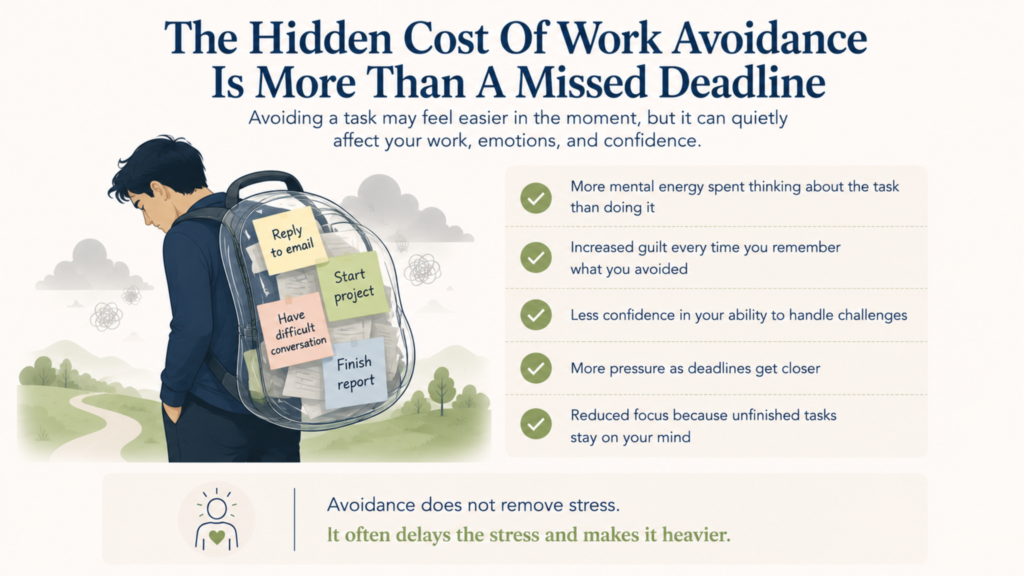
Well, the reason behind work avoidance is connected to emotions, not productivity. In most cases, you are not avoiding the work, you are avoiding the uncomfortable feelings that come with it.
For instance, a difficult project might bring up fear of making a mistake or a presentation might trigger anxiety about being judged. Also, a large task can create a feeling of overwhelm because you do not know where to begin.
Over time, your brain learns that avoiding the task provides temporary relief.
Here are some common reasons people experience work avoidance:
A. Anxiety about making mistakes
For a lot of people, avoiding work is connected to anxiety. You are not avoiding the task because you do not want to do it but because you are worried about what could happen if you do it incorrectly.
For instance, subconsciously you might be thinking:
- What if my work is not good enough?
- What if my manager criticizes me?
- What if I disappoint someone?
- What if I fail?
These thoughts can make even simple tasks feel much harder to start.
This is especially common among people who are highly responsible or have high expectations for themselves, but they’ve been delaying a much needed executive therapy.
B. Feeling overwhelmed and experiencing mental exhaustion at work
Sometimes, the reason you avoid work is not because the task is difficult but because you already feel mentally exhausted.
Think about it.
When you are constantly managing deadlines, meetings, decisions, and responsibilities, your brain has limited energy left for starting another demanding task.
At this point, even a simple assignment can feel overwhelming. You can’t work but you are also unable to relax because you can’t get work done. That’s because mental exhaustion at work makes it harder to:
- Focus on important tasks
- Prioritize responsibilities
- Make decisions
- Start projects
- Stay motivated
C. Perfectionism and fear of failure
Workplace perfectionism is another common reason behind work avoidance.
At first, workplace perfectionism looks like a positive quality. After all, wanting to do your best can help you achieve great results.
But when perfectionism becomes too intense, it can create pressure that makes starting difficult. For instance, you might:
- Spend too much time preparing before beginning
- Keep rewriting something that is already good enough
- Avoid submitting work because it does not feel perfect
- Delay projects because you are afraid they will not meet your standards
The problem is that perfectionism creates an unrealistic expectation. Instead of focusing on progress, your attention becomes fixed on avoiding mistakes.
And when the possibility of failure feels threatening, avoiding work becomes a way to protect yourself.
D. Executive dysfunction at work and task paralysis
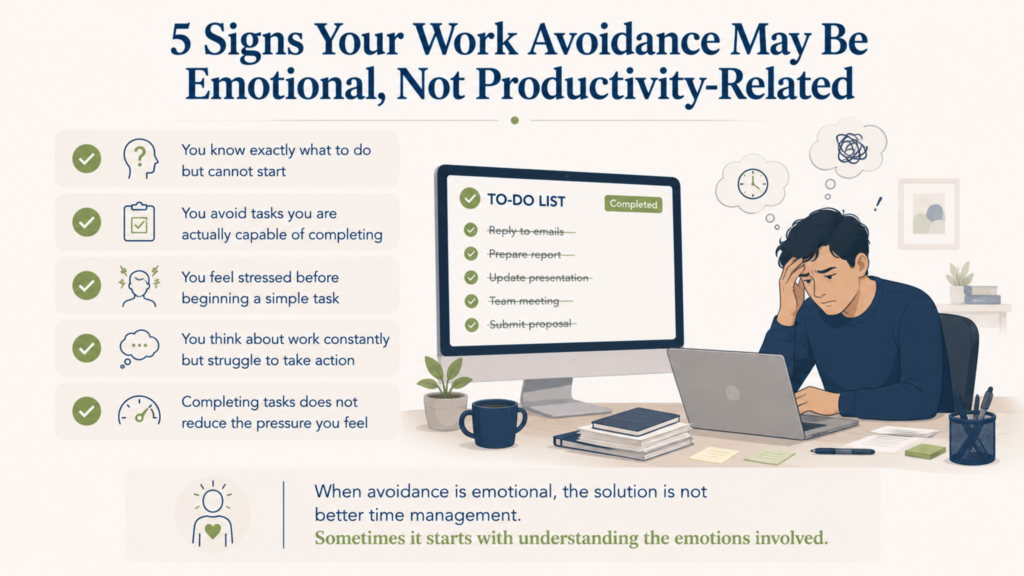
Have you ever looked at a task and thought: I know exactly what I need to do, but I cannot seem to start.
If yes, you have experienced task paralysis.
Task paralysis is when you feel mentally stuck before beginning a task, even when you understand its importance. It can feel like your brain is frozen.
You might:
- Sit in front of your computer but struggle to begin
- Feel overwhelmed by where to start
- Jump between tasks without completing anything
- Avoid tasks that require multiple steps
This is caused by executive dysfunction at work.
You see, executive functioning refers to the mental skills that help you plan, organize, prioritize, manage time, and begin tasks. But when these skills are affected, starting work can become much harder.
Note: While experts claim executive dysfunction is caused by ADHD, stress, anxiety, burnout, and emotional exhaustion also affect executive functioning.
E. Avoiding difficult emotions connected to work
Sometimes, the task itself is not the problem. The feeling connected to the task is.
For instance, you might avoid:
- Opening an email because you expect criticism
- Starting a project because you fear failure
- Going to work because you feel overwhelmed
- Having a conversation because you expect conflict
In these situations, avoidance becomes a coping strategy. Your brain is trying to protect you from discomfort.
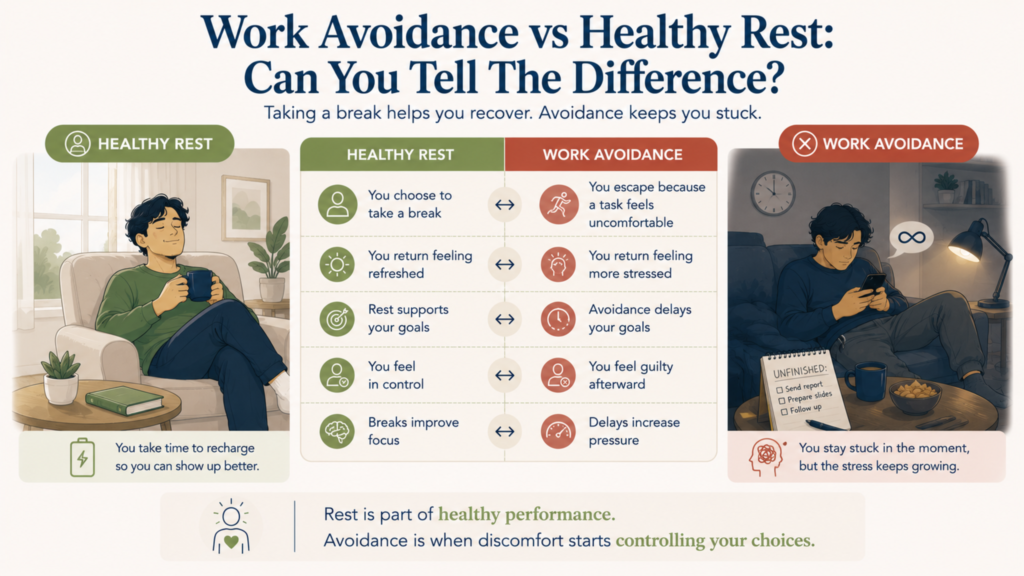
The problem is that while avoidance reduces stress in the moment, it usually makes things harder later.
The task remains unfinished, the pressure increases, and the next time you face a similar situation, avoiding feels even more automatic. This creates an avoidance cycle in the long run.
The work avoidance cycle: Why avoiding work makes it worse
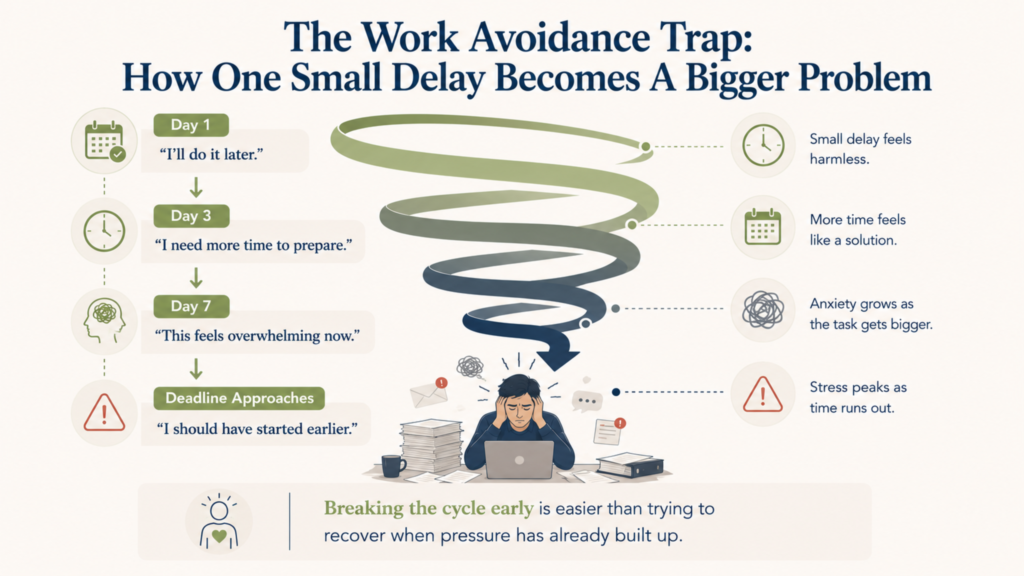
One of the reasons work avoidance can be difficult to break is because it actually feels helpful in the beginning.
When you avoid a stressful task, you feel some immediate relief. For a moment, the pressure goes away.
You don’t have to deal with the uncomfortable feeling, worry about making a mistake, or face the uncertainty of the task.
But the relief is temporary. Soon, the deadline gets closer, the unfinished task starts taking up more mental space, and the anxiety you were trying to avoid becomes even stronger.
Here’s what a cycle of avoidance which looks like:
| Step | What happens |
| Trigger | A difficult, stressful, or overwhelming task appears |
| Emotion | You experience anxiety, fear, frustration, or pressure |
| Avoidance | You delay, distract yourself, or escape the task |
| Short-term result | You feel temporary relief |
| Long-term result | Stress increases and the task feels even harder |
How to stop work avoidance?
When you stop avoiding work, you are not forcing yourself to become more disciplined overnight.
Instead, you first understand the reason behind work avoidance and create healthier ways to respond.
Here are some strategies that help stop work paralysis:
1. Identify what you are actually avoiding
The first step is becoming curious about the pattern.
When you notice yourself avoiding a task, ask: What feels difficult about starting this?
Sometimes the answer is obvious.
You might be avoiding a difficult conversation because you are afraid of conflict or delaying a project because you are worried it will not be good enough. Or maybe you’re putting off work because you are already mentally exhausted.
Understanding the reason behind the avoidance helps you address the actual problem.
For instance, if anxiety is the reason, simply creating a to-do list will not solve the issue. You’ll also need to work on managing the anxious thoughts or seek EMDR therapy for anxiety.
2. Break large tasks into smaller steps
One of the biggest reasons people experience work paralysis is because a task feels too large. When your brain sees something as overwhelming, it becomes harder to know where to begin.
So, instead of focusing on the entire task, focus on the first small step.
For instance, instead of completing the entire report, try to:
- Open the document
- Write the main headings
- Add three key points
- Review the first section
3. Stop waiting until you feel motivated
People assume they need motivation before they can start working. But motivation does not always come first, it develops after you begin.
Think about exercise.
You don’t always feel motivated before a workout. But after you start moving, your energy improves.
The same thing happens with work.
4. Challenge the thoughts that keep you stuck
The thoughts behind work avoidance increase the problem.
For instance:
- I have to do this perfectly.
- If I make a mistake, people will think I am not capable.
- I should already have finished this.
- Everyone else can handle this except me.
These thoughts create more pressure and make starting harder.
The best way to challenge these thoughts is cognitive behavioral therapy. It helps identify these unhelpful thought patterns and replace them with more balanced ones.
5. Create structure and accountability
Sometimes, work avoidance continues because there is too much flexibility. Without clear structure, it becomes easier to delay difficult tasks.
In this case, creating external support can help. This can include:
- Setting smaller deadlines
- Scheduling focused work periods
- Sharing goals with someone you trust
- Creating a consistent routine
Structure reduces the number of decisions you need to make and makes it easier to follow through.
When should you talk to a therapist about work avoidance?
A lot of clients who come to me regarding work avoidance waited until it seriously affected their career.
This is why I always suggest that therapy should not be your last resort. If you understand your avoidance patterns early, therapy can help change them before they create bigger problems.
Overall, you should talk to a therapist if:
- You constantly delay important tasks even when they matter to you.
- Anxiety about work follows you home.
- You feel mentally exhausted most of the time.
- You experience fear of going to work because of stress or overwhelm.
- You feel stuck in a cycle of avoidance, guilt, and pressure.
- Your work stress is affecting your relationships, sleep, or overall well-being.
Therapy can help you understand the emotional reasons behind avoiding work and develop healthier ways to manage stress, anxiety, perfectionism, and pressure.
As a licensed Denver therapist, I help you process stress, anxiety, and past trauma in a safe, grounded space.
To sum up
As you can see, work avoidance is not about being lazy, unmotivated, or lacking discipline.
Most people avoid work as a response to something deeper. It can be anxiety about making mistakes, fear of failure, perfectionism, burnout, mental exhaustion, or simply feeling overwhelmed by everything on your plate.
The problem is that avoiding work provides temporary relief, but it usually increases stress over time. The more you avoid a task, the bigger it can start to feel.
Thankfully, a good therapist can help you identify what is driving your work avoidance, develop healthier ways to manage difficult emotions, and build strategies that make work feel more manageable.
Looking for a therapist in Denver?
You can get in touch with me!
I work with professionals, executives, business owners, and high-achieving adults navigating stress, anxiety, burnout, perfectionism, and the emotional challenges that come with demanding careers.
I use evidence-based approaches like CBT and EMDR, helping clients better understand their patterns, manage difficult emotions, reduce stress, and feel more balanced at work and in their personal lives.
My sessions are available in-person in Denver and virtually across Colorado.
FAQs about work avoidance
What is work avoidance?
Work avoidance is when someone repeatedly delays, escapes, or avoids work-related tasks despite knowing those tasks are important. It is connected to emotions such as anxiety, fear of failure, overwhelm, perfectionism, or stress.
Why am I avoiding work even though I want to do it?
People avoid work even when they genuinely want to complete it because something about the task feels emotionally difficult.
You are avoiding the fear of making a mistake, pressure to perform perfectly, uncertainty about where to start, or anxiety about the outcome.
Is work avoidance the same as procrastination?
Not exactly.
Procrastination means delaying a task even though you intend to complete it later.
Work avoidance involves actively escaping a task because it creates discomfort, stress, anxiety, or overwhelm.
Can anxiety cause me to avoid work?
Yes.
Anxiety can make work feel more threatening than it actually is.
You might avoid tasks because you are worried about making mistakes, receiving criticism, disappointing others, or not meeting expectations. This is exactly the symptom where anxiety therapy becomes helpful.
How do I stop work procrastination and avoidance?
The first step is understanding what is causing the avoidance. Some helpful strategies include:
- Breaking large tasks into smaller steps
- Identifying the emotions connected to the task
- Challenging perfectionistic thoughts
- Creating structure and accountability
- Practicing healthier self-talk
If avoidance is connected to anxiety, burnout, or overwhelming stress, therapy can help address the deeper patterns behind it.
Can therapy help with work avoidance?
Yes.
Therapy can help you understand why you avoid certain tasks and develop healthier ways to respond.
It can be especially helpful when work avoidance is connected to anxiety, perfectionism, burnout, executive dysfunction, or fear of failure.
Licensed Professional Counselor Candidate , MA, LPCC
Kim Hernandez is founder of 12:2 Counseling in Denver, helping individuals address trauma, anxiety, addiction-related patterns, and burnout through EMDR, somatic therapy, CBT, and compassionate body-mind-spirit care that supports steadier relationships, emotional freedom, and lasting change forward.