9 Symptoms Of Emotional Neglect, Their Effects, And Tips To Heal

Written By
Kim Hernandez

Do you sometimes feel emotionally disconnected from yourself or other people?
For instance, you might find it difficult to talk about your feelings or ask for help. Or, you might feel there is something missing inside you even though everything in your life looks fine
Well, these are all connected to emotional neglect during childhood, even though that neglect might not be obvious growing up.
You might have grown up with parents who provided you with food, clothing, education, and everything else you needed physically. But emotionally, you might not have received the same level of attention, comfort, validation, or support.
With time, you would have simply learned to hide your emotions, handle everything on your own, or believe that your feelings or needs aren’t important.
As an adult, this affects the way you see yourself, manage your emotions, and build relationships.
Thankfully, this is not the same as trauma and you might not need EMDR for PTSD. Also, you can detect the symptoms of emotional neglect yourself and heal from it.
In this blog, I have explained it all. So, let’s get started.
Key takeaways
- Emotional neglect happens when a child’s emotional needs are repeatedly ignored.
- Emotional neglect need not always happen intentionally. Parents can still love their children while struggling to meet their emotional needs.
- Common symptoms of emotional neglect include emotional numbness, low self-esteem, perfectionism, people-pleasing, difficulty trusting others, and trouble expressing emotions.
- Healing from childhood emotional neglect is possible through self-awareness, self-compassion, healthier relationships, and professional support.
What does emotional neglect involve?

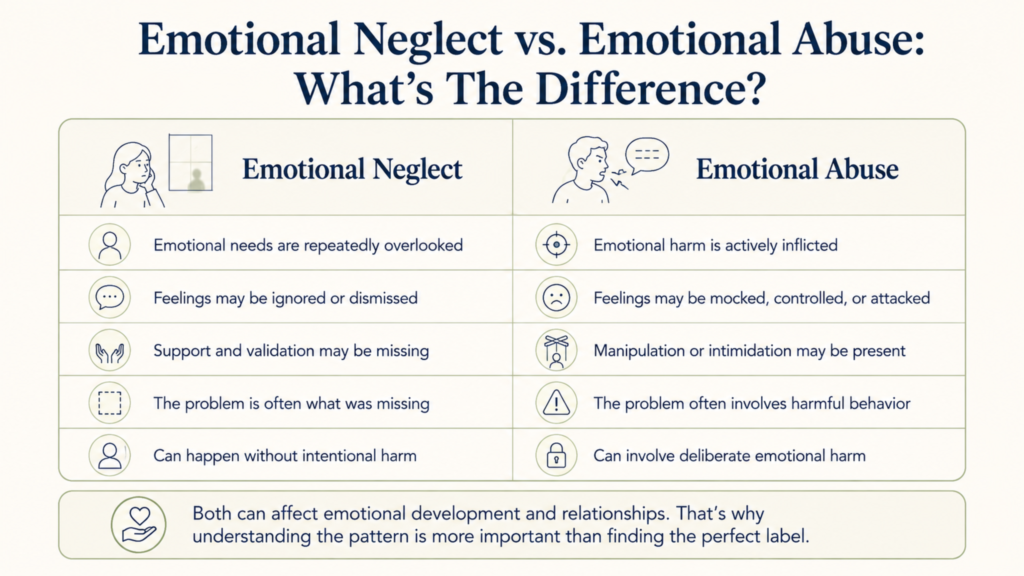
Emotional neglect involves a repeated lack of emotional support, attention, validation, and responsiveness from a parent or caregiver.
For instance, let’s say a child comes home from school feeling upset because their friends excluded them.
Now, instead of asking what happened or helping the child understand their feelings, the parent might say:
- Stop being so sensitive.
- It’s not a big deal.
- You’ll get over it.
One conversation like this does not mean emotional neglect. Parents make mistakes too.
But when a child repeatedly experiences this kind of response, they slowly learn that their emotions are unnecessary or not worth sharing.
This can also happen when a child rarely receives affection, encouragement, comfort, or emotional attention.
As a licensed Denver therapist, I help you process stress, anxiety, and past trauma in a safe, grounded space.

Overall, here are some common signs of emotional neglect:
- Ignoring a child when they are upset
- Telling a child to stop crying or toughen up
- Dismissing fears, sadness, anger, or frustration
- Making a child feel ashamed for having certain emotions
- Rarely offering comfort or affection
- Not listening when a child wants to talk
- Failing to support a child during difficult experiences
- Showing little interest in the child’s hobbies or achievements
- Focusing on performance while overlooking emotional needs
- Ignoring a child’s preferences, opinions, or boundaries
Some common symptoms of emotional neglect you can detect right now
The symptoms of emotional neglect can be different for everyone. While some people become highly independent and rarely ask for help, others become people-pleasers because they learned that keeping everyone else happy was safer than expressing their own needs.
You might also experience emotional numbness, low self-esteem, difficulty trusting people, or a constant feeling that something is missing.
Here are some of the most common symptoms of emotional neglect:
| Symptom | How it can show up |
| Emotional numbness | You struggle to identify or express what you feel |
| Low self-esteem | You feel unimportant or not good enough |
| People-pleasing | You prioritize everyone else’s needs over your own |
| Difficulty trusting | You struggle to depend on or open up to others |
| Perfectionism | You feel you must constantly achieve to feel worthy |
9 Broader symptoms of emotional neglect that you should pay attention to

1. You struggle to understand your emotions
The most common sign of emotional neglect in adults is difficulty identifying what you are really feeling.
You might know that something feels wrong, but you cannot explain what it is. For instance, if someone asks how are you feeling, your immediate response can be: ‘I don’t know.’
This can happen because children learn emotional awareness partly through relationships.
When caregivers notice a child’s emotions, name them, and help the child understand what is happening, the child gradually learns how to recognize and regulate those emotions. But if emotions are consistently ignored or dismissed, you might grow up disconnected from your emotional world.
2. You feel emotionally numb or empty
Another common symptom of emotional neglect is feeling numb, hollow, or disconnected.
You can have positive things happening in your life but still feel like something is missing. Also, you might find it difficult to get excited about things or feel emotionally connected to people you care about.
Sometimes, this numbness is a sign of dissociation and is a way of protecting yourself. And it happens especially if you’ve learned early in life that expressing your emotions did not lead to comfort or support.
However, as an adult, this can make it difficult to experience both difficult and positive emotions fully.
3. You have low self-esteem
When your feelings, opinions, and needs were repeatedly overlooked during childhood, you can start believing that they are not important.
In the long run, this can affect the way you see yourself. You might constantly question whether you are good enough. Also, you can get thoughts like:
- I am not important.
- My problems are not serious enough.
- Other people have it worse.
- I should be able to handle this myself.
- I don’t deserve to ask for more.
These thoughts can become so familiar that you don’t even realize they came from earlier experiences. You simply believe that this is who you are.
4. You are extremely independent
Do you find it difficult to ask anyone for help?
You would rather struggle alone than tell someone that you need support. Also, you might feel uncomfortable depending on other people, even when they have shown you that they care.
This hyper independence can look like strength from the outside. You are capable. handle your responsibilities, and rarely need anyone.
But sometimes, extreme independence is a coping mechanism. If you learned as a child that your emotional needs would not be noticed or supported, you decided that the safest option was to take care of everything yourself.
As an adult, this can make relationships difficult because allowing someone to support you can feel uncomfortable or even unsafe.
5. You struggle with people-pleasing
One of the common signs of emotional neglect in adults is constantly trying to keep other people happy.
You might find it difficult to say no, set boundaries, or tell someone when they have hurt you. Instead, you automatically think about what the other person needs.
You might also think:
- I don’t want to upset them.
- I am being too sensitive.
- It is easier if I just agree.
- I don’t want them to be disappointed in me.
This can happen when you learned early in life that your emotions and needs were less important than keeping the peace.
So, as an adult, you become very good at noticing what everyone else needs while ignoring what you need yourself.
However, people-pleasing can leave you emotionally exhausted and disconnected from your own wants.
6. You find it difficult to trust people
Emotional neglect can also affect how safe you feel in close relationships.
You want emotional connection but struggle to fully trust someone once they get close to you. That’s because you expect people to eventually leave, disappoint you, or stop caring.
You might also find yourself keeping people at a distance because depending on someone feels uncomfortable.
This does not necessarily mean you do not want relationships. In fact, you can deeply want connection.
But when emotional support was inconsistent during childhood, trusting someone with your feelings can feel unfamiliar or even unsafe.
7. You feel guilty for having emotional needs
Have you ever felt like you are asking for too much when you simply want support?
You need reassurance from your partner but feel guilty asking for it. Or you are going through a difficult time but tell yourself that other people have bigger problems.
This is one of the common symptoms of emotional neglect. When your emotional needs were repeatedly overlooked during childhood, you learned that needing comfort is a weakness.
The problem is that constantly ignoring your emotional needs does not make them disappear. It simply makes it harder to recognize and communicate them.
8. You struggle with perfectionism
Symptoms of emotional neglect also show up as perfectionism. You feel that you need to perform well, achieve more, or constantly prove yourself before you deserve approval.
Also, you can feel like you are not doing enough even if you are successful at work.
This happens when approval and emotional connection feel dependent on your behavior or achievements.
You might have learned to believe: ‘If I am successful, useful, or good enough, then people will value me.’
But your worth does not depend on how productive or successful you are. And learning this is an important part of healing emotional neglect.
9. You feel disconnected from relationships
The final symptom I want to talk about is feeling emotionally disconnected from your partner or other people close to you. You have a partner, friends, and family members but still you feel lonely.
You might struggle to share vulnerable thoughts or feel uncomfortable when someone tries to get emotionally close to you.
Sometimes you can even pull away when someone offers genuine support.
This can be confusing. You want connection, but when connection becomes available, you do not always know what to do with it.
This emotional distance can be one of the effects of emotional neglect because childhood relationships help shape the way we understand trust, closeness, and emotional safety.
What are the effects of emotional neglect in childhood?
The effects of emotional neglect in childhood do not disappear when you become an adult. You still carry the emotional patterns you learned as a child into your work, relationships, and everyday life.
For instance, you might struggle with:
- Low self-esteem
- Anxiety
- Depression
- Emotional numbness
- Difficulty expressing emotions
- Problems with boundaries
- People-pleasing
- Relationship difficulties
- Feeling lonely or disconnected
- Difficulty regulating strong emotions
Not everyone who experiences emotional neglect will develop these problems. And having one of these symptoms does not mean you experienced childhood emotional neglect.
But if you notice several of these patterns and they have been present for a long time, it makes sense to introspect and see where they came from.
How to heal from emotional neglect?
A lot of my clients blame their parents for emotional neglect. Also, they’ve spent years trying to understand everything they did wrong.
But these things don’t help healing. Instead, you need to understand what you needed, recognize what was missing, and learn how to meet those emotional needs in healthier ways today.
Overall, here’s how you can start healing emotional neglect:
1. Start noticing your emotions
If you have spent years ignoring your emotions, you cannot suddenly become comfortable with them overnight.
So, start small. When something happens, pause and ask yourself:
- What am I feeling right now?
- What happened?
- What do I need?
- What am I trying not to feel?
You do not need to have the perfect answer. Simply becoming aware of your emotions is a step toward reconnecting with yourself.
2. Learn to validate yourself
You do not need someone else to tell you that your feelings are valid before you are allowed to experience them.
If you are hurt, you are hurt.
If you are angry, something might have triggered that anger.
If you are overwhelmed, you genuinely need a break.
Self-validation does not mean believing that every reaction is automatically correct. You simply need to allow yourself to acknowledge what you are experiencing instead of immediately judging yourself for it.
3. Practice asking for what you need
This can be difficult if you grew up believing that having needs was a burden.
But still, start with small things.
Instead of automatically saying, I am fine,’ try telling someone you trust that you are having a difficult day.
Also, instead of agreeing to something you do not want to do, practice saying no.
These small moments can help you build a healthier relationship with your own needs.
4. Build emotionally safe relationships
Healing becomes easier when you have people around you who listen, respect your boundaries, and make space for your emotions.
You do not need a huge social circle. A few emotionally safe relationships can make a significant difference.
Healthy relationships can also help you learn that vulnerability does not always lead to rejection or judgment.
5. Consider therapy
If emotional neglect has affected the way you see yourself or connect with other people, therapy can give you a safe place to work through these patterns.
Therapy approaches like cognitive behavioral therapy can help you understand where certain beliefs came from, recognize unhealthy coping mechanisms, develop emotional awareness, and build healthier ways of relating to yourself.
As a licensed Denver therapist, I help you process stress, anxiety, and past trauma in a safe, grounded space.
Conclusion
I am sure you now have a better idea about the symptoms of emotional neglect and how they can affect you later in life.
You see, emotional neglect is not always obvious. Sometimes, it looks like having a childhood where everything seemed fine from the outside but your emotional needs were repeatedly overlooked.
And as you grow older, this can show up as people-pleasing, perfectionism, emotional numbness, low self-esteem, difficulty trusting people, or feeling disconnected from relationships.
But these patterns are not permanent. You can learn to understand your emotions, communicate your needs, build healthier relationships, and develop a more compassionate relationship with yourself.
Got more questions or looking for a therapist in Denver?
You can get in touch with me!
I work with professionals, executives, business owners, and high-achieving adults navigating anxiety, depression, burnout, perfectionism, and the emotional challenges that come with demanding careers and personal responsibilities.
I use evidence-based approaches like CBT and EMDR to help clients understand their patterns, process difficult emotions, manage stress, and build a healthier relationship with themselves.
My sessions are available in-person in Denver and virtually across Colorado.
FAQs about emotional neglect
What does emotional neglect involve?
Emotional neglect involves repeatedly failing to recognize, respond to, or support a person’s emotional needs.
In childhood, this can mean a caregiver consistently dismisses feelings, provides little comfort, or does not create enough emotional connection and support.
What are the symptoms of emotional neglect?
Common symptoms of emotional neglect include emotional numbness, low self-esteem, people-pleasing, perfectionism, difficulty trusting people, difficulty expressing emotions, and feeling disconnected from relationships.
What are the signs of emotional neglect in adults?
Signs of emotional neglect in adults include struggling to understand emotions, avoiding vulnerability, feeling guilty about having needs, being extremely independent, and constantly putting other people’s needs before your own.
What are some emotional neglect examples?
Emotional neglect examples include repeatedly dismissing child’s feelings, ignoring them when they need comfort, rarely showing affection, making them ashamed for expressing emotions, or showing little interest in their experiences.
How does childhood emotional neglect affect adults?
The effects of emotional neglect in childhood can continue into adulthood and affect self-esteem, emotional awareness, relationships, boundaries, and the ability to trust and connect with other people.
People might also experience anxiety, depression, emotional numbness, struggling to stop fawn response, or difficulty regulating their emotions.
How do you heal from emotional neglect?
Healing from emotional neglect can involve learning to recognize your emotions, validating your feelings, communicating your needs, building safe relationships, and working with a therapist.
You do not have to figure everything out by yourself. Therapy can help you understand the patterns you developed and learn healthier ways to respond to your emotions and relationships.
Licensed Professional Counselor Candidate , MA, LPCC
Kim Hernandez is founder of 12:2 Counseling in Denver, helping individuals address trauma, anxiety, addiction-related patterns, and burnout through EMDR, somatic therapy, CBT, and compassionate body-mind-spirit care that supports steadier relationships, emotional freedom, and lasting change forward.