How To Find A Therapist For Social Anxiety In Denver? Skills And Qualifications To Look For In 2026

Written By
Kim Hernandez

One of the biggest challenges with social anxiety isn’t just dealing with the anxiety itself. It is asking for help.
If you’ve ever searched for a therapist for social anxiety, you know exactly what I mean.
You spend hours researching therapists, reading profiles, comparing approaches, and wondering whether someone will actually understand what you’re going through.
Then, just when you’re about to reach out, self-doubt kicks in. You wonder:
- What if therapy doesn’t help?
- What if I feel awkward talking about it?
- What if they don’t understand me?
And these concerns are completely understandable.
Social anxiety can make even simple interactions feel stressful. So the idea of opening up to a stranger about your fears can feel overwhelming.
But then, social anxiety is highly treatable. And finding the right therapist can make a significant difference in how quickly and effectively you start feeling better.
In this blog, I will explain how to find a therapist that’s the right fit.
So, read on to know:
- How to find the best social anxiety therapist
- What kind of anxiety therapist in Denver you should look for
- What type of therapy works best for social anxiety
- Questions to ask before starting therapy
- Red flags to watch out for
And much more
Key takeaways
- Social anxiety is highly treatable with the right support
- The best therapist for social anxiety is usually someone who has specific experience treating anxiety disorders
- Cognitive Behavioral Therapy (CBT) is one of the most effective treatments for social anxiety
- Exposure-based approaches are often an important part of treatment
- The relationship you have with your therapist matters just as much as their credentials
- Finding the right therapist can take some research, but it’s worth the effort
What kind of therapist do you need for social anxiety?

For starters, several different mental health professionals can effectively treat social anxiety.
So the most important factor here is not the title itself, but the therapist’s experience, training, and treatment approach.
Overall, here are a few professional titles that quality a professional to treat social anxiety:
| Professional | Can Treat Social Anxiety? |
| Licensed Professional Counselor (LPC) | Yes |
| Licensed Clinical Social Worker (LCSW) | Yes |
| Psychologist (PhD or PsyD) | Yes |
| Psychiatrist | Yes, but often focuses on medication management |
| Marriage and Family Therapist (LMFT) | Yes |
Now, this doesn’t mean one type of professional is automatically better than another.
For instance, a Licensed Professional Counselor (LPC) with anxiety disorder specialization can be a much better fit for social anxiety than a therapist who has little experience treating anxiety.
That’s why I suggest you look beyond job titles and focus on specialization and experience.
As a licensed Denver therapist, I help you process stress, anxiety, and past trauma in a safe, grounded space.

What type of therapy approach is best for social anxiety?
When researching social anxiety therapists, you’ll often see different therapy approaches listed on their website.
And while all approaches claim to be effective, some approaches have stronger evidence for treating social anxiety than others.
Here are some of the most effective approaches to treating social anxiety:
A. Cognitive behavioral therapy (CBT)
CBT or cognitive behavioral therapy is one of the most researched and widely recommended treatments for social anxiety. It focuses on identifying and changing unhelpful thought patterns that contribute to anxiety.
For instance, someone with social anxiety might automatically think:
- Everyone is judging me.
- If I say something wrong, people will think I’m foolish.
- I’m going to embarrass myself.
Now, CBT helps you examine these thoughts and develop healthier, more realistic perspectives. Over time, this can reduce anxiety and increase confidence in social situations.
B. Exposure-based therapy
Many therapists who treat social anxiety also use exposure techniques for treatment.
This doesn’t mean forcing yourself into overwhelming situations. Instead, it involves gradually facing feared situations in a structured and supportive way.
For instance, someone might start by practicing small conversations before eventually working toward larger social situations.
You see, avoidance teaches your brain that a situation is dangerous while exposure helps your brain learn that you can handle the situation safely. And for many people, this becomes an important part of long-term recovery.
C. Acceptance and commitment therapy (ACT)
ACT or acceptance and commitment therapy is another approach that can be very helpful for social anxiety.
Rather than trying to eliminate anxious thoughts completely, ACT teaches you how to respond differently to them.
The goal here isn’t to never feel anxious again. Instead, it’s learning how to move toward the life you want even when anxiety shows up.
People find this approach empowering because it focuses on flexibility and self-compassion rather than perfection.
D. EMDR therapy
Therapists actively use EMDR therapy for anxiety treatment. And it can help with social anxiety as well.
Now, EMDR isn’t typically the first treatment people think about when it comes to social anxiety. However, it can be helpful when social anxiety is connected to painful past experiences like:
- Bullying
- Public humiliation
- Rejection
- Childhood criticism
- Traumatic social experiences
In these situations, EMDR can help reduce the emotional impact of memories that continue to fuel anxiety today.
In short, here are the most effective therapy approaches for social anxiety:
| Therapy Approach | How It Helps Social Anxiety |
| CBT (Cognitive Behavioral Therapy) | Identifies and changes unhelpful thoughts that fuel anxiety. |
| Exposure-Based Therapy | Gradually faces feared social situations to reduce avoidance and build confidence. |
| ACT (Acceptance and Commitment Therapy) | Teaches you to accept anxious thoughts and focus on living according to your values. |
| EMDR Therapy | Helps process painful past experiences that may contribute to social anxiety. |
7 things to look for in a therapist for social anxiety

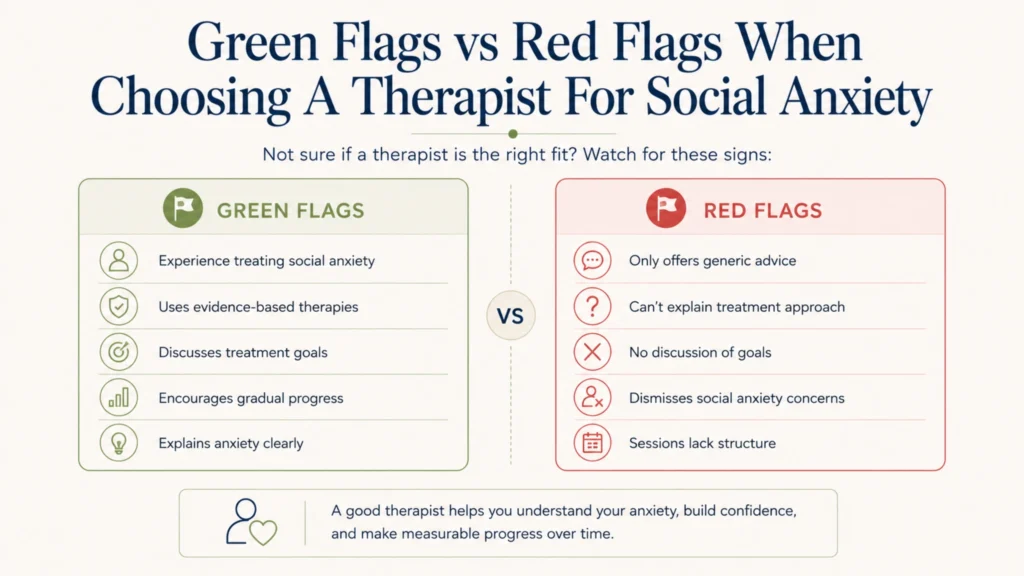
Once you’ve figured out what kind of therapist and therapy approach you want for social anxiety, the next step is figuring out how to actually choose the right therapist.
And this is where most people get stuck.
That’s because almost every therapist profile sounds good on paper. They list anxiety treatment, they mention CBT, and they say they help with confidence and self-esteem.
But here’s the reality: Not every therapist who treats anxiety is experienced in treating social anxiety specifically.
And that difference matters more than you might realize.
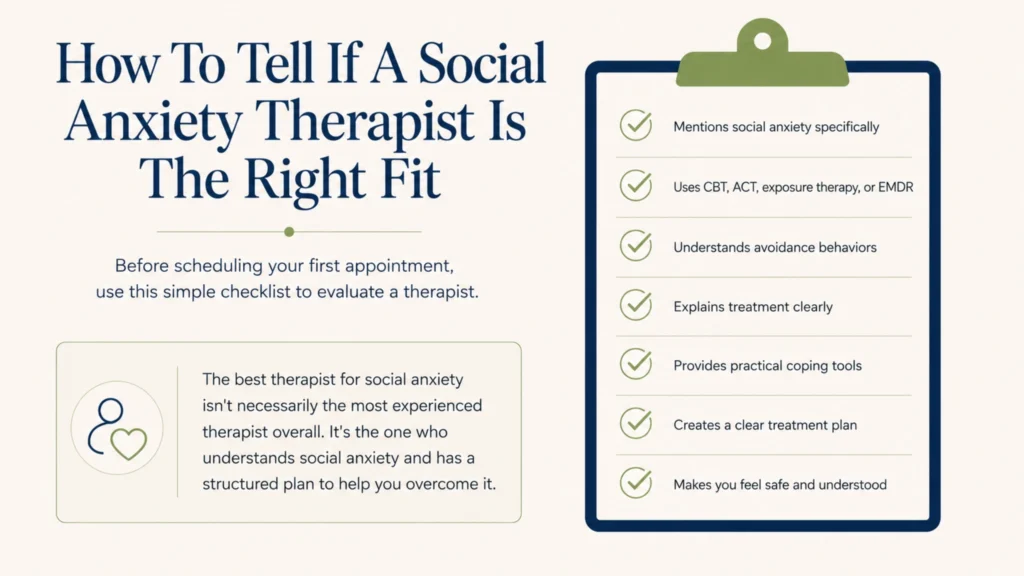
So here are the most important things I suggest you look for when finding a therapist for social anxiety:
1. They specifically treat social anxiety (not just general anxiety)
This is the first filter.
A therapist might say they treat anxiety disorders, but you want to look a little deeper. For instance:
- Do they mention social anxiety explicitly?
- Do they talk about fear of judgment, avoidance, or social situations?
You see, social anxiety has a very specific pattern. And a therapist who regularly works with it will usually describe it clearly on their website or profile.
If they don’t mention it at all, that doesn’t automatically mean they’re not qualified. But it does mean you should ask questions.
2. They understand avoidance (this is important)
One of the core features of social anxiety is avoidance. This includes:
- Avoiding conversations.
- Avoiding meetings.
- Avoiding social events.
- Avoiding situations where you might be judged.
The problem is, avoidance actually strengthens anxiety over time. So a good therapist for social anxiety will understand this cycle clearly.
They won’t just focus on calming you down. They’ll also help you gradually face the situations you’ve been avoiding in a structured way.
3. They use evidence-based approaches
When looking for a therapist specializing in anxiety disorders, this is important.
Evidence-based approaches simply mean therapies that have been researched and shown to work.
And for social anxiety, the most common approaches include:
- CBT (Cognitive Behavioral Therapy)
- Exposure therapy
- ACT (Acceptance and Commitment Therapy)
Now, if a therapist doesn’t mention any of these approaches and only focuses on open-ended talk therapy, it doesn’t necessarily mean it won’t help. But structured approaches do produce more consistent results for social anxiety.
4. You feel comfortable talking to them (even if you’re anxious)
A lot of people think that the best therapist for anxiety is the most experienced one. But in reality, therapy only works if you can actually engage in it.
Now, you don’t need to feel completely comfortable right away. That’s not realistic for social anxiety.
But you should feel a basic sense of safety and respect. If you feel judged, rushed, or dismissed, that’s not the right fit.
5. They focus on practical tools, not just conversation
Some therapy sessions feel like open discussions. And while talking is important, social anxiety treatment usually needs more structure.
A good anxiety therapist will include:
- Thought tracking
- Gradual exposure exercises
- Behavioral experiments
- Coping strategies for real-life situations
You shouldn’t feel like you’re only talking about anxiety. You should feel like you’re actively working on it.
6. They explain your anxiety clearly
This is something a lot of people overlook.
A good therapist for anxiety disorders should be able to help you understand what’s actually happening in your mind and body. Not in a complicated way, but in a simple, grounded way.
You should walk away from sessions thinking: Okay, that actually makes sense now.
After all, when you understand your anxiety, it becomes less scary and more manageable.
7. They create a clear treatment direction
You don’t need a rigid step-by-step plan. But you should have a general sense of direction. For instance:
- What are we working on right now?
- What’s the goal of therapy?
- How will we know things are improving?
Without this, therapy can start to feel unclear or stagnant.
A good social anxiety therapist helps you understand where you are and where you’re going.
In short, here are all the things you should look for in a therapist for social anxiety:
| What to Look For | Why It Matters |
| They specifically treat social anxiety | Shows they understand fear of judgment, avoidance, and social triggers |
| They understand avoidance patterns | Helps you break the cycle that keeps social anxiety going |
| They use evidence-based approaches (CBT, ACT, exposure therapy) | These methods are proven to work for social anxiety |
| You feel safe and comfortable with them | Therapy only works if you can open up and engage |
| They focus on practical tools, not just talking | Builds real-life coping skills and confidence |
| They explain your anxiety clearly | Helps you understand and manage what’s happening internally |
| They provide clear treatment direction | Keeps therapy structured, focused, and goal-oriented |
Bonus: Here are some questions you should ask before starting therapy
If you’re unsure whether a therapist is right for you, here are some helpful questions you can ask during the first consultation:
- Do you work with social anxiety specifically?
- What approaches do you use for anxiety therapy?
- How do you usually help clients with avoidance?
- What does progress usually look like in therapy?
- How structured are your sessions?
- Do you use CBT or exposure techniques?
Note: You don’t need to ask all of these. Even one or two can give you a clearer sense of whether they’re a good match.
How long does social anxiety therapy take to work?
The most honest answer is: It depends.
Some people notice small improvements within a few weeks.
But for others, it takes longer depending on:
- Severity of anxiety
- Level of avoidance
- Past experiences
- Consistency in attending therapy
- Willingness to practice outside sessions
Also, the progress is gradual. Here’s how it looks like:
- Feeling slightly less nervous in situations you used to avoid
- Recovering faster after social interactions
- Noticing fewer “spiral thoughts” afterward
- Gradually doing things you used to avoid completely
It is rarely an overnight shift. But it is a steady one when therapy is working.
As a licensed Denver therapist, I help you process stress, anxiety, and past trauma in a safe, grounded space.
To sum up
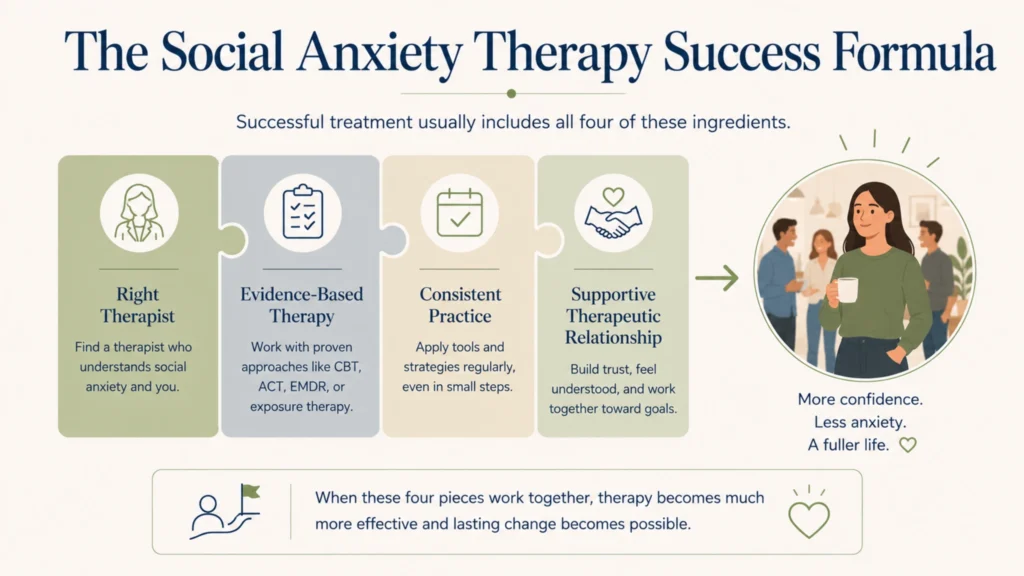
As you can see, finding the right therapist for social anxiety isn’t about choosing the perfect professional. It is about finding someone who understands how social anxiety works and knows how to treat it in a structured, supportive way.
The best therapist for social anxiety will usually:
- Have experience with anxiety disorders
- Use evidence-based approaches like CBT or exposure therapy
- Help you understand your thought patterns
- Guide you through gradual real-world practice
- And support you without judgment
If you’re currently in the process of finding a therapist for anxiety, try not to rush the decision.
Look for a therapist who makes therapy feel clearer, more structured, and more effective. This can make a real difference in how quickly you start feeling like yourself again.
Looking for a therapist in Denver?
You can get in touch with me!
At 12:2 Counseling, I work with adults who struggle with social anxiety, anxiety disorders, and emotional overwhelm. I use evidence-based approaches like CBT and EMDR to help clients reduce anxiety, build confidence, and feel more comfortable in everyday situations.
Sessions are available in-person in Denver and virtually across Colorado.
FAQs about finding a therapist for social anxiety
What kind of therapist do I need for social anxiety?
You don’t necessarily need a specific license type. LPCs, LCSWs, psychologists, and others can all treat social anxiety. The most important factor is whether the therapist has experience treating anxiety disorders and uses structured approaches like CBT or exposure therapy.
What type of therapist is best for anxiety?
The best therapist for anxiety is typically someone who specializes in anxiety disorders and uses evidence-based treatments such as CBT, exposure therapy, or ACT. Experience matters more than title alone.
How do I find a therapist for social anxiety?
Start by searching for therapists who mention social anxiety specifically. Look at their treatment approaches, read their bios, and schedule consultations to see if you feel comfortable with them.
Is CBT good for social anxiety?
Yes. CBT is one of the most researched and effective treatments for social anxiety. It helps you identify and change thought patterns that contribute to anxiety in social situations.
Can therapy actually help social anxiety?
Yes. Social anxiety is highly treatable. With the right therapist and consistent practice, many people see significant improvement in confidence and daily functioning.
How do I know if a therapist is right for me?
You should feel a basic sense of safety and understanding. The therapist should also explain your anxiety clearly and offer a structured approach to treatment. They should also be able to point out whether the underlying cause is agoraphobia or social anxiety.
How long does social anxiety therapy take?
It varies. Some people notice improvements in a few weeks, while others need longer depending on severity and consistency. Progress is usually gradual.
What if I feel too anxious to start therapy?
That’s very common with social anxiety. Most therapists understand this and will go at a pace that feels manageable. You don’t need to feel ready to start.
Licensed Professional Counselor Candidate , MA, LPCC
Kim Hernandez is founder of 12:2 Counseling in Denver, helping individuals address trauma, anxiety, addiction-related patterns, and burnout through EMDR, somatic therapy, CBT, and compassionate body-mind-spirit care that supports steadier relationships, emotional freedom, and lasting change forward.