Is EMDR Covered By Insurance? All Things You Need To Know About Insurance Coverage For EMDR

Written By
Kim Hernandez

Have you been dealing with trauma, anxiety, or PTSD for some time now?
If yes, chances are you’ve considered EMDR therapy or sustained and long-term healing.
But the one question you might have before you sign up for therapy is this: Is EMDR covered by insurance?
After all, starting therapy is already a vulnerable process emotionally. And once you begin footing the costs, the process can start feeling even more overwhelming.
Now here’s the good part: In many cases, EMDR therapy is covered by insurance.
However, coverage depends on factors like your insurance plan, your therapist’s network status, your deductible, and how therapy sessions are billed.
Sounds like too much?
Rest easy, as I will simplify things for you in this blog. You’ll know:
- Whether EMDR therapy is covered by insurance
- Why insurance coverage can vary
- How in-network and out-of-network coverage works
- Whether Medicare covers EMDR therapy
- What questions to ask before starting treatment
And much more
So, let’s get into it.
Key takeaways
- EMDR is often covered by insurance, but coverage depends on your specific insurance plan
- Insurance companies usually cover therapy sessions, not specific therapy techniques like EMDR
- In-network therapists typically reduce out-of-pocket costs
- Out-of-network benefits might still provide partial reimbursement for EMDR therapy
- Deductibles, copays, and session limits can affect total therapy costs
- Medicare might cover EMDR therapy if provided by an eligible licensed mental health professional
- Some therapists provide superbills for insurance reimbursement
- It is completely okay to ask therapists detailed insurance and payment questions before starting therapy
First, what is EMDR therapy?
EMDR stands for Eye Movement Desensitization and Reprocessing. And it is a trauma-focused therapy designed to help people process distressing memories, emotional overwhelm, anxiety, PTSD symptoms, and other trauma-related experiences.
You see, trauma does not only affect thoughts. It can also affect your nervous system, emotional safety, stress responses, sleep, relationships, and the way your body reacts to certain triggers.
And sometimes traumatic memories can begin feeling emotionally stuck. For instance, even long after a difficult experience has ended, your mind and body might continue reacting as if the danger is still present.
This is exactly where EMDR therapy helps.
During sessions, a certified EMDR therapist will use bilateral stimulation techniques like guided eye movements, tapping, or audio tones, helping you process difficult memories safely and gradually. This can help reduce:
- Flashbacks
- Anxiety
- Emotional overwhelm
- Panic responses
- Trauma triggers
- Negative self-beliefs
- Nervous system hypervigilance
As a licensed Denver therapist, I help you process stress, anxiety, and past trauma in a safe, grounded space.

So, is EMDR covered by insurance?

In many cases, yes.
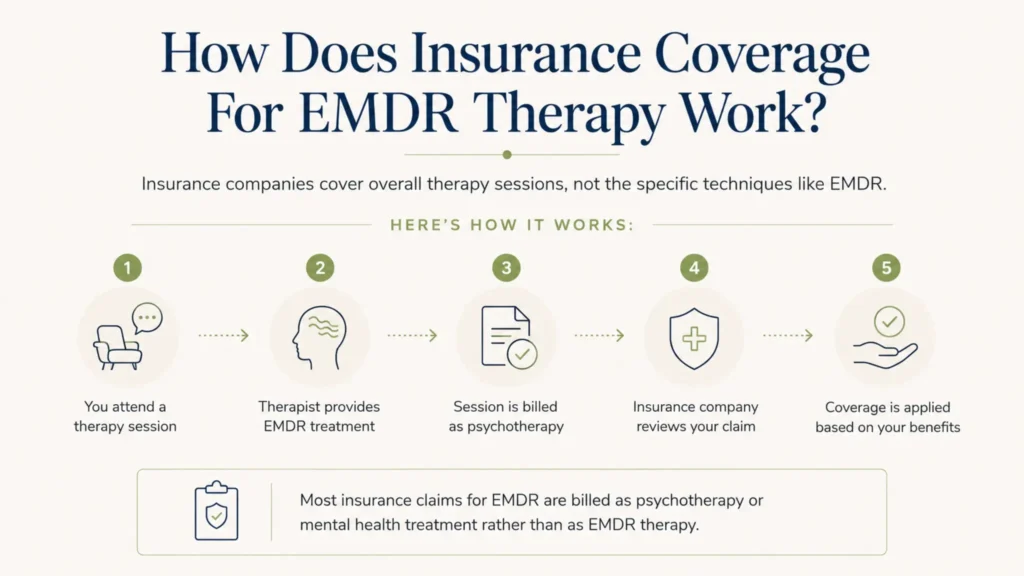
But here’s something important you should know: Insurance companies usually don’t bill separately for EMDR therapy itself. Instead, they generally cover psychotherapy sessions based on:
- Your mental health diagnosis
- Medical necessity
- The therapist’s license
- The billing codes used during treatment
For instance, your therapist may absolutely use EMDR techniques during sessions. But on the insurance side, the session is often billed as:
- Individual psychotherapy
- Trauma therapy
- Mental health treatment
- Behavioral health counseling
Meaning the insurance company might not specifically label the claim as EMDR.
Simply put, insurance covers the therapy session itself rather than the exact therapeutic approach being used during the session.
Here are the factors that affect EMDR insurance coverage:
| Factor | How It Affects Insurance Coverage |
| Insurance plan | Coverage varies between plans |
| Therapist network status | In-network usually costs less |
| Mental health diagnosis | Insurance often requires medical necessity |
| Deductible | Impacts out-of-pocket costs |
| Session limits | Some plans limit therapy visits |
| Medicare/Medicaid rules | Coverage requirements may differ |
Why does insurance coverage for EMDR vary?
One reason why you might feel confused about insurance cover for EMDR is because mental health coverage is not always standardized across plans.
Two people can have completely different coverage experiences even if they both live in Denver and both attend EMDR therapy.
That’s because insurance companies all have different deductibles, copays, provider networks, reimbursement policies, mental health benefits, and authorization requirements.
For instance, one insurance plan might fully cover therapy after the deductible, allow out-of-network reimbursement, and include strong behavioral health benefits Meanwhile, another plan might only cover in-network therapists, require preauthorization, have higher copays, and limit session numbers annually.
This is where you might start feeling confused. More so because insurance language itself can feel unnecessarily complicated sometimes.
Terms like coinsurance, deductible, out-of-pocket maximum, behavioral health benefits, and prior authorization can quickly make the process feel stressful before therapy has even started.
But you don’t need to figure everything out alone. A lot of therapists and counseling practices help clients verify benefits, explain payment options, or provide documentation for reimbursement.
Does insurance cover EMDR therapy if the therapist is out-of-network?
Yes, sometimes it does.
You see, even if a therapist is not directly contracted with your insurance company, your plan might still include something called out-of-network benefits. This means your insurance provider will reimburse part of the therapy cost after you pay for sessions upfront.
Now, reimbursement amounts vary quite a bit depending on your plan. But in many cases, people can still receive partial coverage for EMDR therapy covered by insurance through out-of-network benefits.
This is usually done using a document called a superbill.
A superbill is essentially a detailed receipt your therapist provides that includes:
- Diagnosis codes
- Therapy billing codes
- Session details
- Provider license information
- Payment information
You then submit this document to your insurance company for possible reimbursement.
Depending on your insurance plan, you may receive partial reimbursement, percentage-based reimbursement, or reimbursement after meeting your deductible
Also, in some cases, you might not get any reimbursement at all. That’s why it’s important to verify your specific benefits directly with your insurance provider before starting therapy.
What questions should you ask your insurance company before starting EMDR?
Calling insurance companies can sometimes feel intimidating. A lot of people worry they’ll ask the wrong questions or won’t understand the answers clearly.
But you really don’t need to know complicated insurance terminology beforehand.
You can simply ask: Does my plan cover outpatient psychotherapy sessions with a licensed therapist?
That question alone often gives you most of the information you need.
And if you’re not satisfied, here are some more questions you can ask:
| Question To Ask | Why It Helps |
| Do I have mental health benefits? | Confirms therapy coverage |
| Do I have out-of-network benefits? | Helps if therapist is not in-network |
| What is my deductible? | Determines upfront costs |
| What is my copay or coinsurance? | Helps estimate session costs |
| Do I need preauthorization? | Avoids claim issues later |
| Are there session limits? | Clarifies therapy coverage length |
| What CPT codes are covered? | Confirms psychotherapy billing coverage |
Is EMDR therapy covered by insurance without a diagnosis?
Usually, insurance companies require some form of mental health diagnosis for therapy coverage. That’s because insurance providers generally view therapy as a medical or behavioral health service.
So, in order to approve payment, they can require therapists to document symptoms, emotional distress, functional impact, treatment goals, and medical necessity.
This does not mean you need to sign up for EMDR for severe PTSD, or any other major mental health condition, to attend therapy.
Diagnoses are primarily used for insurance documentation and reimbursement purposes.
Your therapist will explain everything, including:
- Whether a diagnosis is needed
- How insurance billing works
- What information gets shared
- How your confidentiality is protected
Also, if privacy concerns are important to you, it is completely okay to discuss the same before starting therapy.
Does Medicare cover EMDR therapy?
Yes, Medicare covers EMDR therapy in some situations.
But just like private insurance, coverage usually depends on several factors. For instance:
- The therapist must be Medicare-approved
- The services must be considered medically necessary
- Sessions must usually be provided by eligible licensed professionals
Technically, Medicare does not specifically list EMDR as a separate reimbursable treatment category.
However, Medicare might still cover psychotherapy sessions where EMDR techniques are being used as part of treatment.
Is online EMDR therapy covered by insurance?
Sometimes, yes.
Over the past several years, many insurance providers expanded telehealth and virtual mental health coverage significantly. So depending on your insurance plan, online EMDR therapy might still qualify for reimbursement similarly to in-person sessions.
However, coverage can still vary based on your insurance plan, state regulations, therapist licensing, telehealth policies, and network participation.
What are the costs that you might still pay even if insurance covers EMDR?
Even when insurance covers therapy, there might still be out-of-pocket costs involved.
For instance, depending on your plan, you could pay deductibles, copays, coinsurance, and non-covered fees, which is why it helps to know what EMDR therapy costs in Denver before you start.
And if your deductible has not yet been met, you might initially pay the full session cost until insurance begins contributing.
Why do some therapists not accept insurance?

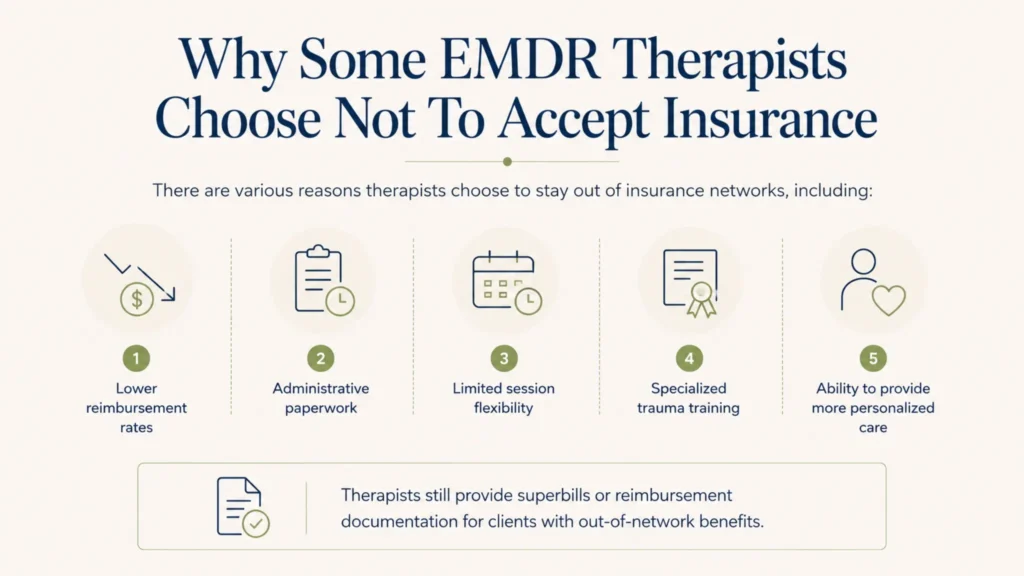
Some therapists choose not to work directly with insurance companies because insurance systems can sometimes create limitations around treatment, documentation, session length, or reimbursement rates.
For instance, insurance companies might require diagnoses, request treatment updates, limit session numbers, sometimes deny claims, reimburse therapists at lower rates, and create lengthy administrative processes.
And for trauma therapy specifically, some therapists feel these restrictions can occasionally interfere with individualized care.
That’s why many EMDR therapists operate as private-pay providers, out-of-network providers, or hybrid practices accepting limited insurance plans.
Now, this does not mean therapy becomes inaccessible. Therapists still help clients use out-of-network reimbursement through superbills.
And some counseling practices intentionally keep parts of their caseload available for sliding scale fees, reduced-rate sessions, and insurance-supported clients.
So even if a therapist is not directly in-network, it is worth reaching out and asking about payment options.
What if insurance denies EMDR therapy coverage?
First, try not to panic.
Insurance denials happen more often than people realize. And sometimes the issue is administrative rather than permanent.
For instance, your claim might get denied because:
- Paperwork was incomplete
- Billing codes were incorrect
- Deductibles were not met
- Preauthorization was missing
- Out-of-network documentation was required
- The claim is still processing
But your therapist or their billing team can help you resubmit claims, provide corrected documentation, submit appeals, and even explain reimbursement options.
Also, if your insurance plan does not cover certain services, you still have alternative options available, including:
- Out-of-network reimbursement
- Payment plans
- Sliding scale therapy
- HSA/FSA accounts
- Lower-frequency sessions temporarily
You see, people sometimes assume one denied claim means therapy is completely inaccessible. But there are still multiple ways to make treatment more manageable financially.
How can you make therapy more affordable?
Mental health care can feel financially stressful, especially when you are already emotionally overwhelmed.
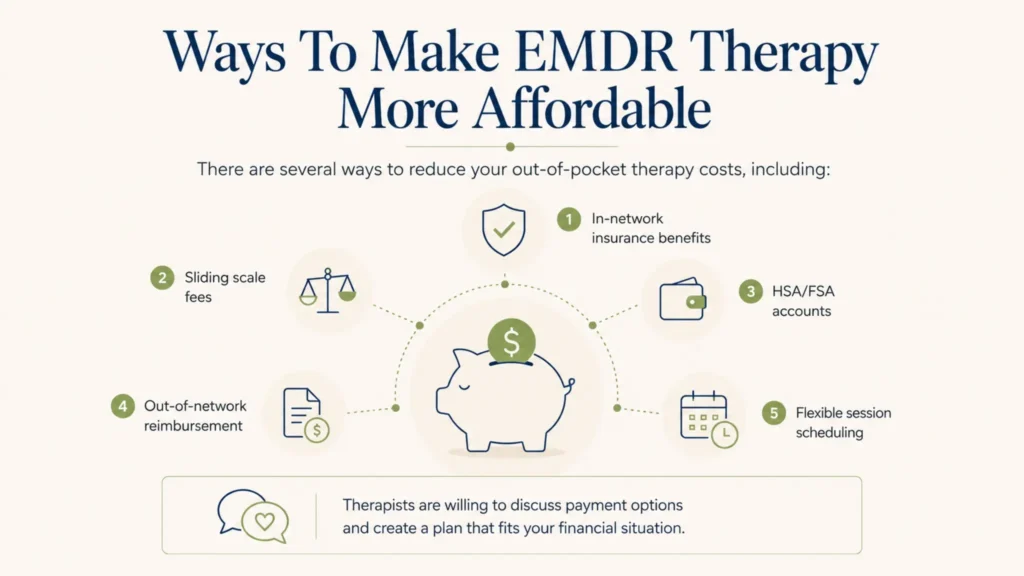
But there are several ways you can reduce therapy costs. For instance, you can:
1. Use in-network insurance benefits
This is usually the most affordable option when available. That’s because in-network therapists have agreements with insurance companies that reduce session fees, copays, and reimbursement complexity.
2. Ask about sliding scale options
Some therapists reserve reduced-fee spots for clients experiencing financial strain. Availability varies, but it never hurts to ask.
3. Use HSA or FSA accounts
Many therapy expenses qualify for health savings accounts (HSA) and flexible spending accounts (FSA) which can help reduce out-of-pocket burden.
4. Explore out-of-network reimbursement
After all, even partial reimbursement can significantly lower long-term therapy costs.
5. Discuss therapy frequency openly
Some clients begin with weekly sessions, biweekly sessions, and phased treatment schedules depending on finances, emotional needs, and treatment goals.
A good therapist will work collaboratively with you whenever possible rather than making finances feel shameful or uncomfortable.
Bonus: Here’s what you should ask a therapist before starting EMDR therapy
Beyond insurance, there are other questions to ask a therapist before your first session.
| Question | Why It Helps |
| Do you accept my insurance? | Clarifies payment options |
| Are you in-network or out-of-network? | Helps estimate costs |
| Do you provide superbills? | Supports reimbursement |
| Do you specialize in trauma or PTSD? | Ensures relevant experience |
| Are you EMDR-trained or EMDR-certified? | Confirms training background |
| What does EMDR therapy usually look like? | Reduces uncertainty |
| Do you offer online sessions? | Helps with flexibility and accessibility |
Wondering how to find a therapist who’ll accept your insurance?
You can read my blog: How To Find A Therapist In Denver.
As a licensed Denver therapist, I help you process stress, anxiety, and past trauma in a safe, grounded space.
To sum up
I am sure by now you have a much clearer understanding of how EMDR covered by insurance actually works.
Figuring out insurance for therapy is not always straightforward. And between deductibles, copays, provider networks, reimbursement policies, and mental health coverage rules, it can feel overwhelming quickly.
But in many cases, insurance does cover EMDR therapy.
And even when full coverage is not available, there are often still ways to make therapy more financially manageable through:
- Out-of-network benefits
- Superbills
- Payment plans
- Sliding scale options
- HSA/FSA accounts
- Flexible scheduling
Got more questions or want to start therapy in Denver, CO?
You can get in touch with me!
At 12:2 Counseling, I help people work through trauma, anxiety, emotional overwhelm, PTSD symptoms, and nervous system dysregulation in a grounded and supportive way.
And if you are considering EMDR therapy in Denver, sessions are available both in-person and virtually throughout Colorado.
FAQs about insurance coverage for EMDR
Is EMDR covered by insurance?
Yes, EMDR therapy is often covered by insurance.
However, coverage depends on your insurance plan, therapist network status, deductible, and mental health benefits.
Does insurance cover EMDR therapy specifically?
Insurance companies usually cover psychotherapy sessions rather than specifically listing EMDR therapy separately. EMDR techniques are often included within covered mental health treatment sessions.
Is EMDR therapy covered by insurance if the therapist is out-of-network?
Sometimes, yes.
Many insurance plans offer partial reimbursement through out-of-network benefits when therapists provide superbills for claims submission.
Does Medicare cover EMDR therapy?
Medicare may cover EMDR therapy when sessions are provided by eligible licensed mental health professionals and considered medically necessary.
Do I need a diagnosis for insurance to cover EMDR?
Usually, yes.
Most insurance providers require a mental health diagnosis to approve therapy coverage and document medical necessity.
Why do some EMDR therapists not accept insurance?
Some therapists choose private-pay models because insurance companies can create restrictions around reimbursement, documentation, session limits, and treatment flexibility.
Is online EMDR therapy covered by insurance?
In many cases, yes.
Some insurance plans now include telehealth mental health coverage for online therapy sessions, including trauma-focused therapy.
How much does EMDR therapy cost with insurance?
Costs vary depending on your insurance plan, deductible, copays, and whether the therapist is in-network or out-of-network.
What if my insurance denies EMDR therapy coverage?
Insurance denials do not always mean therapy is unavailable. Therapists can help with appeals, corrected claims, superbills, or alternative payment options.
How do I verify whether my insurance covers EMDR therapy?
You can contact your insurance provider directly and ask about outpatient mental health benefits, psychotherapy coverage, out-of-network reimbursement, deductibles, and copays.
Licensed Professional Counselor Candidate , MA, LPCC
Kim Hernandez is founder of 12:2 Counseling in Denver, helping individuals address trauma, anxiety, addiction-related patterns, and burnout through EMDR, somatic therapy, CBT, and compassionate body-mind-spirit care that supports steadier relationships, emotional freedom, and lasting change forward.