What Is Therapy For Executives And How Does It Help Leaders In 2026?

Written By
Kim Hernandez

The biggest misconception about therapy is that you have to be falling apart before you seek help. But that’s not true.
In fact, many executives, business owners, and senior leaders start therapy in Denver not because they’re in crisis, but because they’re carrying more than anyone around them realizes.
You see, on the outside, everything might look well. You’re meeting deadlines, solving problems, leading meetings, and supporting your team.
But behind the scenes, the pressure can be constant. You might find yourself replaying difficult conversations long after they’ve ended, feeling mentally exhausted even after a weekend off, or wondering why success doesn’t feel as satisfying as you expected.
With time, this kind of pressure can start affecting not just your work, but your relationships, your health, and your overall well-being.
This is where therapy for executives helps.
Executive therapy doesn’t make you less ambitious or tell you to care less about your work. Instead, it gives you the tools to manage stress effectively, navigate leadership challenges with confidence, and protect your mental health while continuing to perform.
In this blog, I have explained it all. Read on to know:
- Why so many leaders experience stress, anxiety, and burnout
- How executive therapy benefits business leaders
- What happens during executive therapy sessions
- The therapy approaches that work best for executives
- Signs it might be time to talk to a therapist
And much more
Key takeaways
- Therapy for executives is designed to help leaders manage stress, burnout, anxiety, and the unique pressures of leadership.
- Executive therapy isn’t just for people in crisis. Many high-performing professionals use it as a proactive form of support.
- Therapy can improve emotional resilience, decision-making, communication, and work-life balance.
- Approaches like Cognitive Behavioral Therapy (CBT), Acceptance and Commitment Therapy (ACT), and EMDR can all be helpful depending on your needs.
- Seeking support is a sign of self-awareness, not weakness.
What is therapy for executives?

For starters, therapy for executives is a form of counseling that helps business leaders, executives, entrepreneurs, and other professionals navigate the emotional and psychological demands of leadership.
While the core principles of therapy remain the same, executive therapy focuses on challenges that often come with high levels of responsibility. This includes:
- Chronic stress
- Executive burnout
- Leadership anxiety
- Difficult workplace relationships
- Decision fatigue
- Perfectionism
- Work-life imbalance
- Managing conflict
- Feeling isolated in a leadership role
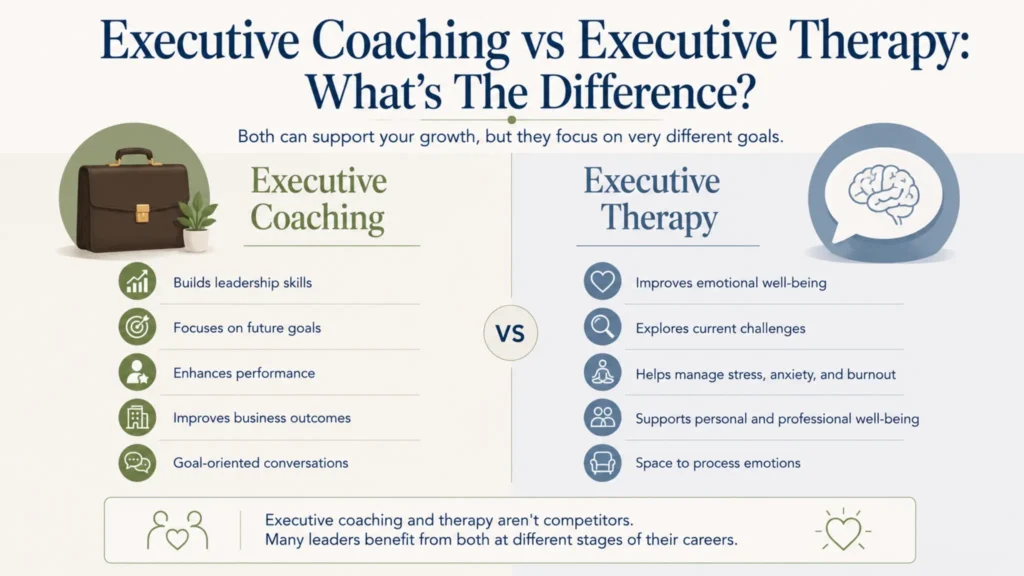
Unlike executive coaching, which focuses on improving performance or achieving specific business goals, therapy looks at the emotional factors influencing how you think, feel, and lead.
For instance, an executive coach helps you become a better communicator during board meetings.
A therapist for executives, on the other hand, helps you understand why certain conversations trigger anxiety, why it’s difficult to set boundaries, or why stress recovery is harder than before. This understanding makes a big difference not only in your personal life but also in the way you lead.
Who is executive therapy meant for?
Executive therapy isn’t only for CEOs. People who benefit from therapy include:
- Business owners
- Senior managers
- Physicians
- Attorneys
- Founders
- Directors
- Entrepreneurs
- High-achieving professionals
- Anyone in a leadership position with significant responsibility
Simply put, if your role involves making important decisions, managing people, or carrying responsibilities that others depend on, executive therapy provides a space to process those challenges without judgment.
As a licensed Denver therapist, I help you process stress, anxiety, and past trauma in a safe, grounded space.

Why do so many leaders seek executive therapy?
From the outside, it can seem like executives have everything under control. They’ve built successful careers, they’re leading teams, and they solve complex problems every day.
So it’s easy to assume they don’t need support.
But here’s the reality: The very qualities that help someone become a successful leader can also make them more vulnerable to stress, anxiety, and burnout.
Think about it.
As an executive, you’re expected to stay calm during uncertainty, make difficult decisions with limited information, and support the people around you even when you’re feeling overwhelmed.
That’s a lot for one person to carry.
And unlike many other roles, leadership can also be surprisingly isolating.
You’ll feel like you can’t openly share your concerns with employees. You’ll also not want to burden your family with work stress. And talking to colleagues might not always feel appropriate.
Over time, those feelings can start to build. And without a healthy outlet, the pressure can become hard to manage.
Here are some common reasons executives decide to start therapy:
A. Executive burnout
Burnout doesn’t happen overnight. It builds gradually after months or even years of constant pressure, long hours, and little time to recover.
At first, you’ll simply feel tired or start waking up depressed in the morning. Then you notice that you’re becoming less patient.
Even small problems will feel much bigger than they used to. And decisions that once came easily will now feel mentally exhausting.
Eventually, the work you used to enjoy can start feeling like another obligation.
These are some of the common executive burnout symptoms:
- Feeling emotionally or physically exhausted
- Losing motivation for work
- Difficulty concentrating
- Detachment from work or team
- Increased irritability
- Trouble sleeping
- Feeling like you’re always ‘on’
Note: Leaders think they just need a vacation. But while taking time off can help, burnout goes deeper than simple fatigue.
Stress management therapy helps you understand what’s contributing to the burnout and develop healthier ways to manage stress.
B. Constant stress and executive anxiety
A certain amount of stress comes with almost every leadership role. But when that stress never really goes away, it can start affecting your mental and physical health.
You might constantly think about work after hours, struggle to relax on weekends, or find yourself worrying about decisions long after you’ve made them.
In the long-run, this can contribute to executive anxiety.
Now, it might not always look like panic attacks. It can show up as overthinking, difficulty switching off, emotional dissociation, muscle tension, irritability, or constantly feeling like you need to stay one step ahead.
Therapy helps you recognize these patterns and develop stress management strategies before they begin affecting your work, relationships, or health.
C. Decision fatigue
Executives make countless decisions every single day. Some are small, while others can affect employees, clients, finances, or the future of an entire organization.
Even when you’re good at making decisions, that constant mental effort takes energy. And after a while, it can become harder to think clearly, prioritize effectively, or feel confident in your choices.
Therapy gives you a place to slow down, organize your thoughts, and process the pressure that comes with carrying so much responsibility.
D. Feeling like you always have to be the strong one
Many leaders feel responsible for keeping everyone else motivated.
They support their teams through challenges, solve problems, and stay composed when things go wrong.
But who supports them?
For many executives, there isn’t an easy answer.
And constantly feeling like you have to be the strong one can become emotionally exhausting.
This is where therapy offers a confidential space where you don’t have to have all the answers. You can simply be honest about what you’re experiencing without worrying about how others will respond.
E. Perfectionism and the pressure to keep achieving
Successful professionals set incredibly high standards for themselves.
That drive can be one of the reasons they’ve achieved so much. But it can also make it difficult to slow down, celebrate accomplishments, or accept mistakes.
Instead of feeling satisfied after reaching a goal, the focus quickly shifts to the next challenge. And this cycle can contribute to high achiever burnout.
Here, therapy for high achievers helps you recognize when ambition is serving you and when it’s quietly becoming a source of unnecessary stress.
The idea isn’t to lower your standards, but to help you pursue success in a way that’s healthier and more sustainable.
In short, here are some common reasons leaders seek executive therapy:
| Common challenge | How therapy can help |
| Executive burnout | Reduce chronic stress and rebuild healthy coping strategies |
| Executive anxiety | Manage worry, overthinking, and emotional pressure |
| Decision fatigue | Improve clarity and reduce mental overload |
| Leadership isolation | Provide a confidential space to process challenges |
| Perfectionism | Develop healthier expectations while maintaining high performance |
| Work-life imbalance | Create boundaries that support long-term well-being |
What are the benefits of therapy for executives?
People think therapy only helps when something is wrong. But many executives use therapy because they want to function better, not just feel better.
In other words, therapy isn’t about taking away your ambition. Instead, it is meant to help you lead without sacrificing your mental health.
So, with time, executives notice benefits that extend beyond the therapy room.
For instance, they become better at managing stress during difficult situations instead of carrying that stress home every evening. Also, they communicate more clearly because they’re responding thoughtfully rather than reacting emotionally.
They even go on to set healthy boundaries, delegate responsibilities, and recover after demanding periods at work.
These changes also improve life outside of work. For instance, executives who have been feeling disconnected from partner due to work stress find ways to reconnect.
They even become more effective leaders. That’s because when you’re less overwhelmed, it is easier to think clearly, make balanced decisions, and stay present with the people who depend on you.
Overall, here are some of the biggest benefits of executive therapy:
| Benefit | How it helps |
| Better stress management | You respond to pressure without becoming overwhelmed |
| Reduced burnout | You build healthier habits that support long-term performance |
| Improved decision-making | You think more clearly during high-pressure situations |
| Greater emotional resilience | You recover more quickly from setbacks and challenges |
| Stronger relationships | You improve communication at work and at home |
| Better work-life balance | You set healthier boundaries without sacrificing your goals |
| Increased self-awareness | You understand patterns that influence your leadership and well-being |
What happens during executive therapy?
If you’ve never been to therapy before, you might be wondering what an actual session looks like.
Some people imagine lying on a couch while someone silently takes notes. But modern therapy looks very different.
Most therapy sessions feel like a structured conversation. You’ll talk about what’s been happening in your work and personal life, the challenges you’re facing, and the patterns you want to change.
And depending on your goals, your therapist might help you:
- Identify sources of stress that keep showing up
- Recognize thinking patterns that increase anxiety or self-pressure
- Develop healthier ways to respond to difficult situations
- Improve communication and boundary-setting
- Build practical coping strategies for stressful work environments
- Process experiences that continue to affect your confidence or well-being
For instance, let’s say you’re constantly replaying conversations after leadership meetings and worrying that you said the wrong thing.
Now, rather than simply telling you to stop overthinking, a therapist would help you understand what’s driving those thoughts and teach you practical strategies to respond differently.
What therapy approaches work best for executives?
When you’re looking for a therapist for executives, you’ll come across different therapy approaches. And while these are all effective, some approaches are especially helpful for professionals dealing with stress, anxiety, burnout, or leadership challenges.
Here are few common approaches used during therapy for professionals:
A. Cognitive behavioral therapy (CBT)
Cognitive behavioral therapy is among the most widely researched and effective therapies for anxiety and stress. It focuses on identifying thought patterns that may be increasing emotional distress.
For instance, beliefs like ‘I can’t make a mistake,’ ‘If I say no, I’ll let everyone down,’ or ‘I have to handle everything myself’ contribute to stress, perfectionism, and burnout.
CBT helps examine these thoughts and replace them with more balanced and realistic ones.
B. Acceptance and commitment therapy (ACT)
Acceptance and commitment therapy takes a slightly different approach. Instead of trying to eliminate difficult thoughts completely, it teaches you how to respond to them more effectively.
For many leaders, stressful thoughts aren’t something that completely disappear. There will always be uncertainty, responsibility, and difficult decisions.
ACT helps develop the psychological flexibility to keep moving toward your goals without letting anxiety make every decision for you.
C. EMDR therapy
Sometimes, current stress isn’t just about what’s happening today. It can also be connected to experiences from the past. This can include:
- A difficult former workplace
- Repeated criticism
- A toxic manager
- A career setback
- Other stressful or traumatic experiences
Now, when these experiences continue to influence how you respond today, EMDR therapy can be helpful.
Yes, the cost of EMDR therapy is slightly higher, but it does help the brain process distressing memories so they become less overwhelming.
In short, here are therapy approaches used in executive therapy:
| Therapy approach | How it can help |
| CBT | Helps change thought patterns that contribute to stress, anxiety, and perfectionism |
| ACT | Builds psychological flexibility and resilience during challenging situations |
| EMDR | Helps process difficult past experiences that continue to influence the present |

How do you know it’s time to see a therapist?
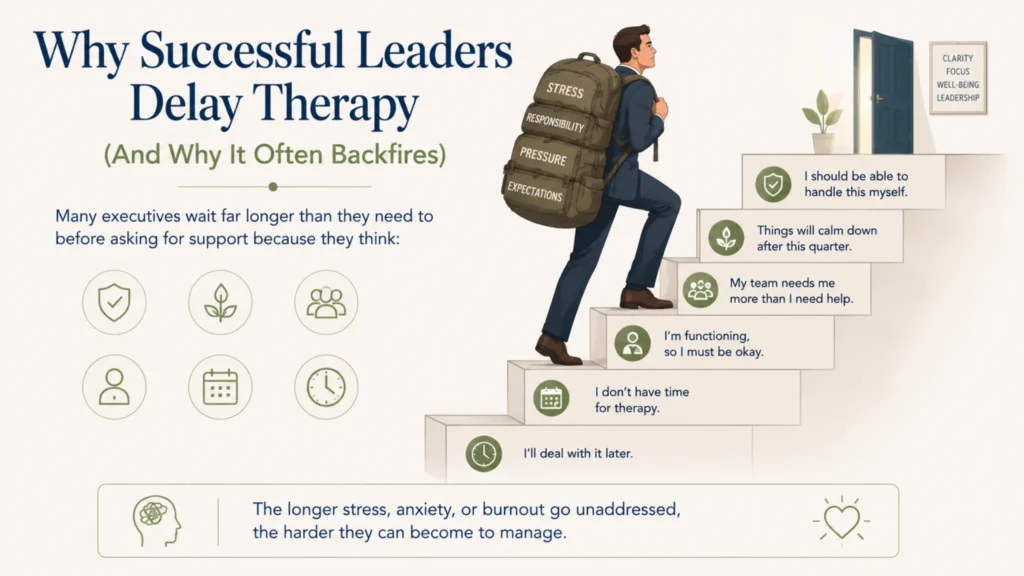
Many executives wait until they’re completely overwhelmed before asking for help. But therapy doesn’t have to be a last resort.
In fact, seeking support earlier makes it easier to address challenges before they grow into something bigger.
Overall, you might benefit from counseling for executives if:
- Work stress follows you home every day.
- You are experiencing work avoidance or feel mentally or emotionally exhausted.
- You’re finding it harder to make decisions than you used to.
- You’re becoming more irritable or impatient with people around you.
- You’re struggling to disconnect from work, even during time off.
- Anxiety is affecting your sleep, relationships, or overall well-being.
- Success no longer feels as rewarding as it once did.
You don’t have to check every box on this list. Sometimes, simply feeling like you’ve been carrying too much on your own is reason enough to reach out.
The earlier you address stress, burnout, or anxiety, the easier it often becomes to regain a sense of balance.
As a licensed Denver therapist, I help you process stress, anxiety, and past trauma in a safe, grounded space.
To sum up
As you can see, therapy for executives isn’t about fixing someone who’s failing. It involves supporting people who are carrying significant responsibility and helping them navigate that responsibility in a healthier, more sustainable way.
A good therapist can help you better understand your stress, develop practical coping strategies, and build habits that support both your personal well-being and professional success.
Whether you’re experiencing executive burnout, managing constant pressure, or simply looking for a confidential space to process the challenges of leadership, therapy can provide meaningful support.
Looking for a therapist in Denver?
You can get in touch with me!
I work with executives, business owners, professionals, and other high-achieving adults navigating stress, burnout, anxiety, and the demands of leadership.
I use evidence-based approaches like CBT and EMDR to help clients better manage stress, reduce burnout, strengthen resilience, and feel more grounded both at work and at home.
My sessions are available in-person in Denver and virtually across Colorado.
FAQs about therapy for executives
What is therapy for executives?
Therapy for executives is a specialized form of counseling that helps leaders manage the unique emotional and psychological demands of leadership.
It can help with executive burnout, stress, anxiety, decision fatigue, perfectionism, relationship challenges, and maintaining a healthier work-life balance.
Is executive therapy only for CEOs?
No. While CEOs can certainly benefit from therapy, executive therapy is also helpful for business owners, entrepreneurs, directors, physicians, attorneys, managers, and other professionals in leadership positions.
Anyone carrying significant responsibility at work can benefit from having a confidential space to process stress and develop healthier coping strategies.
Can therapy help with executive burnout?
Yes.
Therapy can help you identify what’s contributing to burnout, develop healthier ways to manage stress, set better boundaries, and rebuild habits that support long-term well-being.
Rather than simply addressing the symptoms, therapy also explores the underlying patterns that may be keeping burnout going.
What’s the difference between executive coaching and executive therapy?
Executive coaching typically focuses on improving leadership skills, communication, or business performance.
Therapy, on the other hand, focuses on your emotional well-being, helping you understand the thoughts, behaviors, and experiences that affect both your mental health and your ability to lead effectively.
What type of therapy works best for executives?
There’s no single approach that’s right for everyone. However, therapies like Cognitive Behavioral Therapy (CBT), Acceptance and Commitment Therapy (ACT), and EMDR are commonly used to help executives manage stress, anxiety, burnout, and other leadership-related challenges.
How do I know if I need executive therapy?
If you’re constantly feeling overwhelmed, emotionally exhausted, struggling to disconnect from work, or noticing that stress is affecting your relationships, health, or decision-making, therapy can be worth considering. You don’t have to wait until you’re in a crisis.
Licensed Professional Counselor Candidate , MA, LPCC
Kim Hernandez is founder of 12:2 Counseling in Denver, helping individuals address trauma, anxiety, addiction-related patterns, and burnout through EMDR, somatic therapy, CBT, and compassionate body-mind-spirit care that supports steadier relationships, emotional freedom, and lasting change forward.